Saturday, August 20, 2016

RPG a Day - Day 20

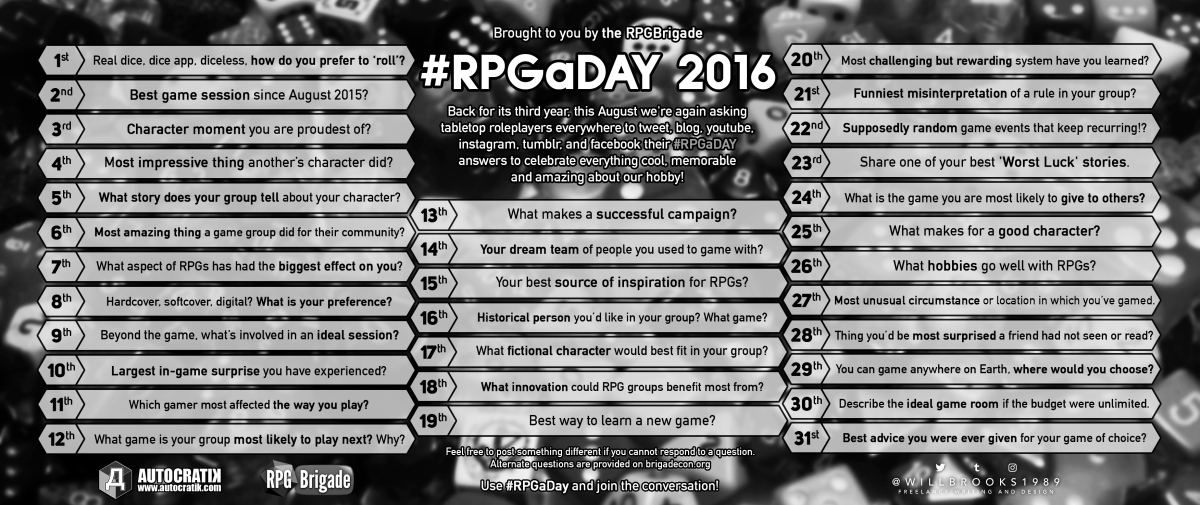
Today's topic: What is the most challenging, but rewarding, system you've learned?

This answer might strike folks as strange, but I'd say 4th Edition Dungeons and Dragons.

This game (which I'll abbreviate as 4E) was controversial when it was released. Its predecesor, third edition (3.5E,) was tremendously popular, but it had accrued a great deal of cruft in the form of splat books. When 4E came along, it turned a great number of the mechanics that had been endlessly reiterated in 3.5E and turned them on their heads. It's probably too much to recount the differences here, but suffice it to say that many of the features players considered "core" to the D&D experience, such as Vancian magic, were exchanged for new systems.

For some people, the new system was fundamentally broken. It simply wasn't something they could enjoy, and they'd stick with 3.5E thank you very much. For others, it could have been a reasonably fun game if it just didn't have the D&D label on it. Regardless of who you asked, it was a substantially different experience from 3.5E.

The Challenge

Coming in to run the game for the first time, I had a number of hurdles to overcome. This included, but wasn't limited to:

  • Pacing the game against player resources, such as healing surges and powers
  • Understanding the role of combat in a session, and how to pace it appropriately
  • Properly utilizing the Skill Challenge system
  • Motivating players to use Rituals effectively
  • Rewarding players without trivializing the challenges
I could go on. The point is that there was a new mindset needed, and a lot of things to consider, when running this system. It couldn't be run in the same fashion as a 3.5E game. There were many elements "out of the box" that needed tinkering to get the most mileage out of them. It came with a lot of trial and error. 

The Reward

I shouldn't have to explain this one too deeply. I've written quite a bit about the 4E campaign I ran for my group. It was one of the longest games I've run, it ended after about 15 sessions, and everyone seemed to enjoy it throughout. I had lots of player investment in the setting, there was good roleplaying throughout, and the ending was satisfying all around.

Now that 5th Edition has been released, a lot of people have moved on from 4E. I don't blame anyone, but I consider it a game I'd return to again. I learned how to get the most of the system when I ran it, and I think it can be a fun system to play again and again. 

Except for Grappling Rules. Those are never rewarding. Comic by Shamus Young.

Friday, August 19, 2016

RPG a Day - Day 19

Today's topic: What's the best way to learn a new game?

I have a lot of experience learning new games, thanks to Charm City Game Day, run by my friend Larry.  I saw some games I'd never even heard of in the past and met some awesome people this way, by the way. The next one is just around the corner, September 17. If you're in greater Baltimore/DC area, you should consider coming out for this.

In any case, I've found that immersion is the best way to learn a new game. Most people, if they've played any sort of RPG before, understand that if their character sheet says, "Sneaking +5," then if they decide to sneak, they'll get a +5 to their rolls. That's relatively intuitive for even the greenest of gamers.

For more complicated rules, though? Demonstrations are worth their weight in gold. For example, I mentioned a few days ago that I loved Fate Points. This system isn't always intuitive to players right away, whether they're seeing a written description or the GM is explaining it to them at the table. Show them the different ways they work in the first five minutes of the game, however, and they'll catch on quickly.

Another helpful element of jumping into the game is to simply ask the players to declare their actions and start getting into the rule details as things come along. For example, perhaps the players are a spaceship crew, and you tell them that their destination is blocked by debris. One player says, "My character is the ship's navigator. Can I pilot us through the wreckage?" Great, this is the perfect time to talk about how piloting a ship works in this game.

This appraoch also works because the players will ask questions as they come up. To use the same example, another player might say, "My character has a bonus in 'Heavy Weapons' and training in 'Ship Weaponry.' Is there a difference? 'Cause I'd like to use the ship's guns to clear a path in the debris." This makes a great time to talk about those differences and the mechanics for shooting the ship's weapons.

You might not think it'd make a difference, but if you'd tried to throw all of that at the players before starting, plus whatever other explanations you think they'd needed, it probably would have gotten lost in the din.

Some other good advice for teaching a new system:

  • Provide a copy of quick-start rules if you can. It can speed up the game if the players have something to reference for their questions on basic mechanics within the system.
  • Keep it simple. Some systems can get incredibly complicated, and the game can get bogged down in the details if you throw too much at the players at once. 
  • Limit the options. The players' primary vehicle for interacting with the world is the collection of knobs and levers that make up the character sheet. Don't put anything on there that you know won't get used in the game. 
  • If the characters are divided into different classes or roles, make certain that all of those roles are show-cased and useful in your game.
The last thing I'd say about all of this is to make the game fun. Nothing about the system or the mechanics will matter if nobody actually enjoys the adventure. 
September 17. Put it on your to-do list.

Thursday, August 18, 2016

RPG a Day - Day 18

Today's topic: What innovation could RPG groups benefit from most?

Most readily, I think RPG groups could benefit from smart phone integration.

Think about it. Most likely, everyone at your table is carrying one. There's probably a good chance they're already looking at it throughout the game session. I think there's an obvious opportunity for apps which make integrating them into the game a smooth endeavor. I realize that there are programs out there that would cover most of the functions I'm thinking about here, but something that made it more seamless, especially in the context of a group of people sitting around at a gaming table, would probably be very popular.

As for innovations that aren't really prominent, I'd be delighted to see how the digital table top endeavor is coming along.

If you're not familiar with it, the idea was to take advantage of the boom in touch screen technology to create a digital, interactive table top display.
Something like this.
Supposedly, this was something WotC was working on back in the days of D&D 4th edition, but seems to have abandoned the project for various reasons. Most likely cost; a quick google search shows digital table tops available, but with costs running in the $8-10k range. Yikes.

The advantages of such tech are obvious: High quality visuals without having to buy printed maps all the time. (Generally) easy to interact with. Lots of possibilities for a variety of systems.

I know people already simulate such things using projectors and virtual table top programs such as Roll20, but this always felt like the inevitable progression of the hobby. (Throw in smart phone integration as I discussed above, and you've got a solid gold project there.)

Wednesday, August 17, 2016

RPG a Day - Day 17

Once again, I'm skipping the scheduled topic for one I find more interesting. Today's topic: What is your favorite revolutionary game mechanic?

I'm not sure how you'd define "revolutionary" in this context, but discovering Fate Points was a moment of awakening for me. To explain why, it would help to start from the beginning.

I started gaming back in 2007 with D&D (3.5). It's a system people love to death, enough so that when WoTC moved on to 4th Edition, people stuck with a new version of D&D 3.5, Pathfinder. I point that out just to say that it's obviously a system with redeeming qualities if people loved it this much, but it places a lot of the narrative control in the hands of the GM. Players are generally limited to interacting with the game by the "buttons and levers" on their character sheet. This is why magic users are often considered so much more powerful in those systems; they just have more options for interacting with the world than the martial classes.

Even so, that ability to interact with the world is still limited to the effects described within the rules. If the player wants to interact with the game itself, it's entirely at the discretion of the GM.

Fate Points changed that in a way that I love. They give the players a way to interact with the game that goes beyond the mechanics defined on the character sheet. A player can spend a Fate Point to, for example, declare a detail about the world, or force a certain behavior onto an NPC. In some systems, similar types of resources can be spent to declare a PC automatically succeeds at his action.

It's an incredible method for the game to become much more interactive to the players, and not just the characters. It provides means for them to be much more creative and contribute in ways that the GM may never have anticipated. It's also a great vehicle for the GM to reward the players. It's frequently the case that a player might have a great moment at the table: He comes up with a great plan, does something hilarious, or capitalizes on a dramatic moment that impresses everyone. Fate Points are a good way for the GM to reward such moments. In a system like D&D, there's no obvious way to handle this.

Like I've said, there are similar systems out there, but Fate Points were my first encounter with this sort of mechanic, and I love it. It's why Fate remains one of my favorite systems.
Besides, there's just something satisfying about passing tokens back and forth.

Tuesday, August 16, 2016

RPG a Day - Day 16

I don't care for the scheduled topic for today, so I'll grab one from yesteryear: What's your favorite RPG accessory?

For this, it would have to be my dice box. Find me a gamer who doesn't revel in his method for storing and transporting dice? A lot of people start off with the classic Crown Royal bag. Just google "dice bag" and you can see the wide variety people make them in. They come in chain mail, they come in scales, they look like monsters, they look like people. As I recall, one of the Fear the Boot hosts has a dice bag made from a kangaroo's scrotum. (Although I hear it's probably wallaby.)

My dice box isn't nearly so exotic, but I still love it. The box itself looks like a big six-sided die, so I'm storing my dice in a die. Silly? Sure. Nerdy pleasure? Oh, yes.

It's not a great transport method, mind you. It doesn't fit well in any bags, it's bulky, it takes up a lot of room at the table, and digging dice out of it is a noisy affair. Still, it's mine and I love it.
Very similar to this. 

Monday, August 15, 2016

RPG a Day - Day 15

Today's topic: What is your best source of inspiration for RPGs?

In general? Television.

It's actually a great medium for pilfering ideas. Most of your stories are either set up to be resolved over a 30-60 minute episode, or in bits and pieces over the course of a season. That's a very similar structure to most RPGs, which will either resolve plots over a single game session or over the course of several sessions that form a campaign.

Of course, it also depends on how you're swiping from the medium. Things like pacing, structure, or general plot lines can be great ideas to pull. Get too specific about the details, though, and you could end up with problems. You might end up expecting your players to respond the way the characters in the show did, which is never a good strategy because it's risky to expect the players to respond in any given manner.

Another problem you might run into is the players actually recognizing the source of your inspiration. If you borrowed too liberally, it can spoil the entire outcome for them. For example, for my short-lived Sentinels of the Multiverse RPG, the plot was essentially the first season of Young Justice, abbreviated to fit into six sessions and adjusted to be specific to the Sentinel Comics setting.

It was a fun game, to be sure, but one of my players recognized it right away, which definitely had a deleterious effect on his enjoyment of the game.
The members of Young Justice Sentinels


Sunday, August 14, 2016

RPG a Day - Day 14

I can't really say anything interesting about today's topic. Instead, I'll cover one of the topics from last year: What is your favorite media property you wish was an RPG?


I had to think on this one a while, because an awful lot of my favorite media properties already are RPGs, or at least have one in their name.

I think a really interesting game could be made from Deus Ex. It's a series of action games with strong cyberpunk elements focusing on the discovery and disruption of vast government conspiracies. The games were great fun. (Well, except for that one.) 

Of course, I know there's already one big cyberpunk RPG out there. Is another property really necessary? Wouldn't it be easier to just import the setting while using the system?

It can vary. Sometimes you can get away with adopting an existing system to a property and just ignoring the rules that aren't relevant and house-ruling the things that need to be specific. Other times crafting a ruleset specific to the setting makes for a better game, as it accounts for the idiosyncracies particular to that property.

Which category does Deus Ex fall into? I've only played Shadowrun once, so I can't really say with any certainty if it does the job or not. I wouldn't mind seeing a take on it, though. 
We definitely didn't ask for this.

Saturday, August 13, 2016

RPG a Day - Day 13

Today's topic: What makes a successful campaign?

I haven't played a lot of campaigns, but I've read much about others' campaigns. By far, the one element that every successful campaign shared was that they were completed. Many a campaign crashes on the rocks and never reaches its destination. Those campaigns that actually reach a conclusion? Rare.

The biggest mistake I see GMs make is a misunderstanding of their players' appetites and enthusiasm for the campaign being played. The GM conjures a truly epic campaign, an adventure spanning years of game time and passing from levels 1 to 20, until the characters slay the greatest evils and ascend to godhood. In his mind, it will become the game that defines them as a group.

Then the players get three sessions in and say, "This isn't really cutting it for us. Want to play Star Wars?"

Alternatively, the GM comes in with no solid plan, no "path" between the start and the end of his campaign. The adventure meanders about from one thing to another. Eventually the players start to wonder, "Is this going any where? Or are we just playing modules until you get bored of running the game?"

The point here is that your players aren't just your friends, or your game group, they're your audience, and "Know your audience" is timeless advice. Do they want to play the RPG equivalent of War and Peace? Do they want something episodic that can be picked up or shelved at will? Perhaps they just want a short, self-contained adventure arc, to see if they have any real interest in your game.

Maybe you get a few sessions in and they realize they don't enjoy this the way you thought they would; can you adjust the pace to renew their interest, or at least end things before they revolt?

Nobody will ever go broke betting against the successful completion of a campaign. Avoiding that fate means knowing what your players want out of a game and matching your plans accordingly.

Comic made by the estimable Shamus Young.

Friday, August 12, 2016

Chasing the Wind - A Legacy of Knowledge

A while back, Neil DeGrasse Tyson was speaking in front of an audience, and was asked, "What is the meaning of life?" This was his answer:
So — what is the meaning of life? I think people ask that question on the assumption that 'meaning' is something you can look for and go, 'Here it is, I found it. Here's the meaning. I've been looking for.' That scenario, however, doesn't consider the possibility that 'meaning' is something you create. You manufacture it for yourself and for others. 
So when I think of 'meaning' in life, I ask, 'Did I learn something today that I didn't know yesterday, bringing me a little closer to knowing all that can be known in the universe?' If I live a day and I don't know a little more than I did the day before, I think I wasted that day. So the people who, at the end of the school year, say 'The summer! I don't have to think anymore!' — I just don't know. To think brings you closer to nature. To learn how things work gives you power to influence events. Gives you power to help people who may need it — to help yourself and your trajectory. 
So when I think of the meaning of life, that's not an eternal and unanswerable question — to me, that's in arm's reach of me everyday. So to you, at age six-and-three-quarters, may I suggest that you explore nature as much as you possibly can. And occasionally that means getting your clothes dirty because you might want to jump into puddles and your parents don't want you to do that. You tell them that I gave you permission.
His questioner was six years old, so you can see how this is an answer for a child on some level. He might just as well have added, "Eat your veggies and drink your milk." You can also see the post-modern perspective in there as well, replacing Meaning with "meaning," where "Whatever gets you through the day" is meaningful. To each his own, etc. I'll have to address that another day.

All the same, Tyson is a scientist (well, depending on who you ask), and this is definitely a scientist's answer on the question of Meaning.

RPG a Day - Day 12

Today's topic: What game is your group most likely to play next?

Bleh. I don't really have a group at the moment, given that I moved away from my previous gaming group last year. I could go ahead and say, "D&D," because that's the most likely answer wherever my gaming feet land next. But I think I'll take the opportunity to answer more interesting questions instead, by delving into last year's RPG a Day topics.

The topic up for consideration: What forthcoming game are you most looking forward to?

If you couldn't guess from my previous posts, I'm very much looking forward to the Sentinels of the Multiverse RPG. I was so excited about this game I developed my own system in Fate just to bide the time.

Unfortunately, it seems like I'll be waiting a while. The game was announced more than a year ago, and since then, it doesn't seem to have progressed in any way. No official announcements from Greater Than Games or Critical Hit Studios about the project. Supposedly they've been discussing it at major gaming conventions such as GenCon, but that's not really what I would call an official announcement, since the only things I can find out about that are what people have to say about it on forums. 

They're doing alpha-level previews at these conventions, but they were doing the same last year. The impression I get is that the GtG crew wants to finish work on Oblivaeon before getting to the RPG. That makes sense, but then one wonders what Critical Hit's role in this is if GtG has to be so intimately involved in the project.

I'm sure I'll be delighted with the final product, but here's hoping it shows up before 2018; given that the Sentinels of the Multiverse card game is finished, I'm worried that by the time the RPG is actually released, the interested audience will have dwindled.

Thursday, August 11, 2016

RPG a Day - Day 11

Today's topic: Which gamer most affected the way that you play?

On this topic, I've gotta give credit to the cast of Fear the Boot. I've been listening to their podcast for years, even before I started into RPGs in the first place. They've been a constant source of gaming advice over the years, not to mention a great source of entertainment.

If you wanted to summarize their gaming advice, it would boil down to "Don't be a jerk to your fellow players, and talk about your disagreements like adults." Which is great, but you can't make a podcast out of that little bit. Thankfully, the FtB hosts always have a great deal to say about all the various things that make the hobby so much fun.

If you've never listened to it, consider giving it a go. There is an obvious love for the hobby in their work. They definitely have fun when recording their show, as evidenced by the number of "bonus" episodes where they can't actually stay on a gaming topic. Plus, their show is very well edited, so you don't get the weird pauses and cross-talk that happens in some amateur podcasts. (I say amateur because none of the hosts actually get paid for making the show. They did start a Patreon this year, but that is largely to pay someone else to edit the episodes for them, as it's become too time-consuming for Dan to handle.)


Wednesday, August 10, 2016

RPG a Day - Day 10

The topic for today: What is the largest in-game surprise you have experienced?

This answer only technically applies, but it was still a surprise, so I'm going to run with it.

I ran a Dresden Files campaign for my group a few years ago. During the course of the adventure, my players came into conflict with Bob. If you asked what Bob's High Concept was, his character sheet would read "Evil Hillbilly Psychomancer." Bob was a bad man; the details as to how are unimportant.

What ended up being the big surprise to me was how much the players connected with him. Oh, not in a good way, mind you. They wanted to kill him. They were pretty clear about this. The party's warden had a great deal of enthusiasm for cutting Bob's head off.

I'm not entirely certain what it was that set them off on Bob. Perhaps his exaggerated drawl combined with the arrogance that accompanies power landed just right. Maybe it was his eagerness to hurt innocents just to get their attention.

Either way, Bob ended up being a big surprise for me in that game. My one regret was that his role ended up being very small in the game overall. Had I been thinking, I'd have capitalized on their fixation with him and given him a larger role in the game.
Y'all minds belong to me, now.

Tuesday, August 09, 2016

RPG a Day - Day 9

Today's topic: Beyond the game, what's involved in an ideal session?

Ah, this can be a frustrating topic. Often times what makes a session ideal is like lightning in a bottle; you can't recreate the conditions if you tried.

I could write a big list of things that you need, but I think the biggest item that is needed, beyond the actual game, is engagement.

Which is to say, you need the players to be on board with the game. They need to be interested in the story, ready to interact with the NPCs, eager to play to their own characters. They need to surprise you with outside the box thinking, finding solutions you didn't anticipate and possibilities within the game that you hadn't considered.

The corollary need from the GM is that you need to be nimble with your plot points, entertaining with your NPCs, flexible with the direction of your story, having a complete command of your established facts and your PCs' backstories.

You can see why I described this as bottled lightning. Lots of room for this to fall apart, if for no other reason than someone having an "off" day. GM didn't get a lot of sleep the night before. One of the players fought with his kids before arriving late. The host is so stressed from getting everything in order before people showed up that he can barely concentrate on the game.

I guess that's why it's an "ideal" session. At least everyone has "that session," the one that went perfectly, the one that everyone in the group talks about for years afterwards, when everything fell into place.

Monday, August 08, 2016

RPG a Day - Day 8

Today's topic is on RPG book preference: Hardcover, softcover, or digital?

I consider this kind of like comparing apples and oranges. That is to say, they can both be great, but your reasons for enjoying an apple are going to be quite different from enjoying an orange*.

As with dice, there's something about a physical product that the reality of digital books simply can't replicate. The advent of eReaders and digital books has changed a lot about the industry, but there's no replacing the feel of a physical book.
Hey guys, check out my book collection!
With the physical books, there's no doubt that a hardcover often makes for an attractive feature on your bookshelf in a way a paperback can't. Conversely, paperbacks usually have a much, much better price point, though I've rarely seen publishers put their big releases in a paperback form.

Digital copies are often at a similar price point as paperbacks, and they're very useful in their own way, but there's one particular difficulty I've found with them: Loaning. If you want someone to check out a game system, or even just to look something up for you, it's really simple to pass a book to him. If all you have is a PDF copy, you can still pass it on, but that's . . . not entirely legal.

So, what do I prefer? It's rather a moot point; I buy so few RPG books generally that it's usually just a question of what product they've actually made available.


* - On an unrelated note, someone should really create a word that rhymes with orange for the sole purpose of having a word that rhymes with orange.