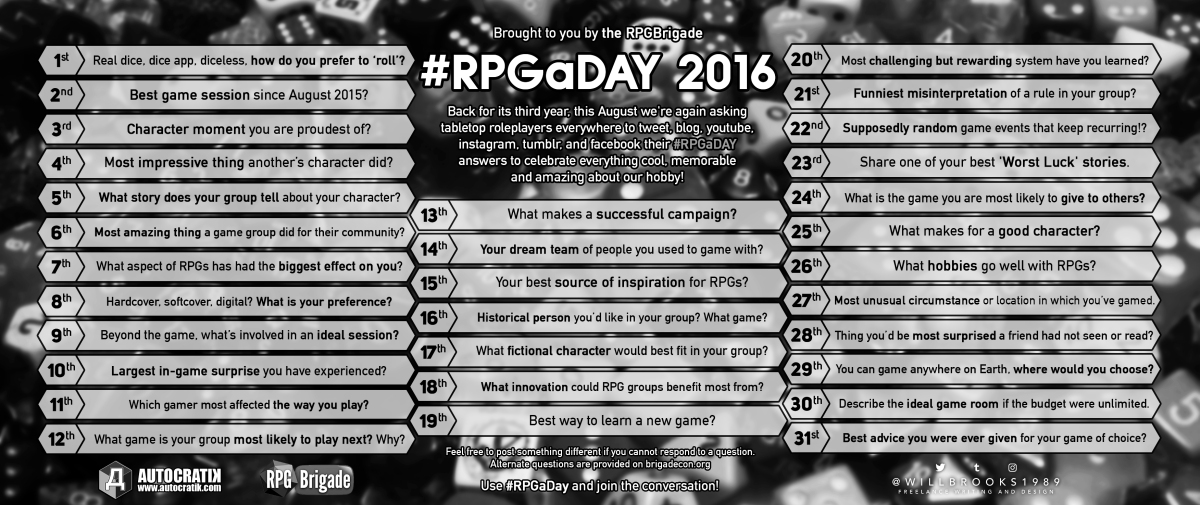
Today's topic: Beyond the game, what's involved in an ideal session?
Ah, this can be a frustrating topic. Often times what makes a session ideal is like lightning in a bottle; you can't recreate the conditions if you tried.
I could write a big list of things that you need, but I think the biggest item that is needed, beyond the actual game, is engagement.
Which is to say, you need the players to be on board with the game. They need to be interested in the story, ready to interact with the NPCs, eager to play to their own characters. They need to surprise you with outside the box thinking, finding solutions you didn't anticipate and possibilities within the game that you hadn't considered.
The corollary need from the GM is that you need to be nimble with your plot points, entertaining with your NPCs, flexible with the direction of your story, having a complete command of your established facts and your PCs' backstories.
You can see why I described this as bottled lightning. Lots of room for this to fall apart, if for no other reason than someone having an "off" day. GM didn't get a lot of sleep the night before. One of the players fought with his kids before arriving late. The host is so stressed from getting everything in order before people showed up that he can barely concentrate on the game.
I guess that's why it's an "ideal" session. At least everyone has "that session," the one that went perfectly, the one that everyone in the group talks about for years afterwards, when everything fell into place.
Tuesday, August 09, 2016
Monday, August 08, 2016
RPG a Day - Day 8
Today's topic is on RPG book preference: Hardcover, softcover, or digital?
I consider this kind of like comparing apples and oranges. That is to say, they can both be great, but your reasons for enjoying an apple are going to be quite different from enjoying an orange*.
As with dice, there's something about a physical product that the reality of digital books simply can't replicate. The advent of eReaders and digital books has changed a lot about the industry, but there's no replacing the feel of a physical book.
With the physical books, there's no doubt that a hardcover often makes for an attractive feature on your bookshelf in a way a paperback can't. Conversely, paperbacks usually have a much, much better price point, though I've rarely seen publishers put their big releases in a paperback form.
Digital copies are often at a similar price point as paperbacks, and they're very useful in their own way, but there's one particular difficulty I've found with them: Loaning. If you want someone to check out a game system, or even just to look something up for you, it's really simple to pass a book to him. If all you have is a PDF copy, you can still pass it on, but that's . . . not entirely legal.
So, what do I prefer? It's rather a moot point; I buy so few RPG books generally that it's usually just a question of what product they've actually made available.
* - On an unrelated note, someone should really create a word that rhymes with orange for the sole purpose of having a word that rhymes with orange.
I consider this kind of like comparing apples and oranges. That is to say, they can both be great, but your reasons for enjoying an apple are going to be quite different from enjoying an orange*.
As with dice, there's something about a physical product that the reality of digital books simply can't replicate. The advent of eReaders and digital books has changed a lot about the industry, but there's no replacing the feel of a physical book.
| Hey guys, check out my book collection! |
Digital copies are often at a similar price point as paperbacks, and they're very useful in their own way, but there's one particular difficulty I've found with them: Loaning. If you want someone to check out a game system, or even just to look something up for you, it's really simple to pass a book to him. If all you have is a PDF copy, you can still pass it on, but that's . . . not entirely legal.
So, what do I prefer? It's rather a moot point; I buy so few RPG books generally that it's usually just a question of what product they've actually made available.
* - On an unrelated note, someone should really create a word that rhymes with orange for the sole purpose of having a word that rhymes with orange.
Sunday, August 07, 2016
RPG a Day - Day 7
The topic for today: What aspect of RPGs has had the biggest effect on you?
On a personal level, RPGs introduced me to some lifelong friends. It's an inherently social activity, so it's only natural that you find some camaraderie with your fellow players.
When I moved out to Baltimore back in 2008, I didn't know anybody, and I worried that I'd have a difficult time making friends. Graduate school tends to be rather time consuming, so it can be difficult to get a robust social network.
Just before moving, through Fear the Boot's forums, I met Larry. I needed a gaming group. Larry's group had room for another player. It was a happy coincidence.
Through Larry, I met several other men who would become my closest friends for the duration of my time in Baltimore. It was with tremendous sorrow that I left them behind to move back to St. Louis.
Still, let it not be said that RPGs didn't have a positive effect in my life.
Saturday, August 06, 2016
RPG a Day - Day 6
Today's topic: What's the most amazing thing a game group did for their community?
I listen to a gaming podcast called Fear the Boot. One of the members/friends of the Fear the Boot community is a man by the name of Scott Bonner. Scott is the director of the Ferguson Public Library.
As you might recall, Ferguson experienced some social unrest back in 2014 following the police shooting of Michael Brown, as well as the subsequent declination of a Grand Jury to press charges against the involved officer.
During the riots and protests in this time, Ferguson schools closed for various reasons. The library, however, remained open as a safe place for students and parents alike. They even invited teachers to come to the library to hold classes or tutoring sessions, anything that would help the students keep their education moving while the turmoil played out.
In recognition of Scott's great care for his community and the role the library played, the Ferguson Public Library was named "Library of the Year" in 2015.
In addition to all of that, the Fear the Boot community takes care of its own. The podcast hosts a gaming convention in the St. Louis area each year, Fear the Con. In recent years, each con has featured one or two charities in focus; no admission is charged for attendance, but attendees are asked to support the charities.
For the 2015 Fear the Con, the Ferguson Public Library was one of the featured charities.
Now, I don't know how much money was raised during the event. You could ask Dan or Derek about that. Regardless, Scott did a great job as a leader in his community, and his gaming community rose up to support him. I think that's a story worth telling.
I listen to a gaming podcast called Fear the Boot. One of the members/friends of the Fear the Boot community is a man by the name of Scott Bonner. Scott is the director of the Ferguson Public Library.
As you might recall, Ferguson experienced some social unrest back in 2014 following the police shooting of Michael Brown, as well as the subsequent declination of a Grand Jury to press charges against the involved officer.
During the riots and protests in this time, Ferguson schools closed for various reasons. The library, however, remained open as a safe place for students and parents alike. They even invited teachers to come to the library to hold classes or tutoring sessions, anything that would help the students keep their education moving while the turmoil played out.
In recognition of Scott's great care for his community and the role the library played, the Ferguson Public Library was named "Library of the Year" in 2015.
In addition to all of that, the Fear the Boot community takes care of its own. The podcast hosts a gaming convention in the St. Louis area each year, Fear the Con. In recent years, each con has featured one or two charities in focus; no admission is charged for attendance, but attendees are asked to support the charities.
For the 2015 Fear the Con, the Ferguson Public Library was one of the featured charities.
Now, I don't know how much money was raised during the event. You could ask Dan or Derek about that. Regardless, Scott did a great job as a leader in his community, and his gaming community rose up to support him. I think that's a story worth telling.
Friday, August 05, 2016
RPG a Day - Day 5
Today's RPG a Day topic: What story does your group tell about your character? Unfortunately, I don't really have a good way to answer this. Like Larry, I haven't actually been a player much in the last few years, and even then, as I said previously, my characters haven't been terribly dynamic.
So I'm glad the BrigadeCon folks provided alternative questions for just such circumstances. The question I'll actually handle for today: What are good ways the group can support the host on game night?
The most visible example of this in our group was Mr. Jar.
Our host was kind enough to provide soda and snacks regularly for us when we would game. It probably doesn't surprise you to hear that six grown men can consume a lot of soda over the course of an evening, so Mr. Jar was the collection plate, with a regular friendly reminder that the jar provided the refreshments.
Sometimes Mr. Jar bought pizza or new games, but mainly it was to keep the expense of hosting us to a minimum.
There's more, though. Our group changed over the course of my time with them: People got married and had kids, including our host. These life changes meant gaming changes as well, but we were flexible guests, which made a huge difference. This included:
So I'm glad the BrigadeCon folks provided alternative questions for just such circumstances. The question I'll actually handle for today: What are good ways the group can support the host on game night?
The most visible example of this in our group was Mr. Jar.
Our host was kind enough to provide soda and snacks regularly for us when we would game. It probably doesn't surprise you to hear that six grown men can consume a lot of soda over the course of an evening, so Mr. Jar was the collection plate, with a regular friendly reminder that the jar provided the refreshments.
Sometimes Mr. Jar bought pizza or new games, but mainly it was to keep the expense of hosting us to a minimum.
![]() |
| Of course, none of us could agree on beer, so Mr. Jar tended towards teetotalism. |
- Tolerating breaks in the action for spousal/parental duties
- Attempting gaming efficiency since our schedule was necessarily limited
- Keeping our voices down after the children went to bed
- Helping to clean up after the session
- Helping to entertain the kids when the parents' attention is divided
I'm sure there are other ways RPG groups can make life easier on their host, but these were the best ways we helped ours.
Thursday, August 04, 2016
RPG a Day - Day 4
Today's gaming topic: What is the most impressive thing another's character did?
I know exactly the story I want to tell here, and I love telling it. Sadly, I can't remember which character this gets attributed to, but it's a good story all the same.
My players were to infiltrate the keep in a heavily fortified city. Their contact with the local Resistance offered them a few possible options for getting in. One option involved the commanding General of the garrison in this place, whose birthday was being celebrated in the keep that night; they could enter as guests and then sneak off to conclude their business.
The option they went with was to pose as arcane technicians. Due to recent hostilities, the military was upgrading the magical defenses and wards for their most important facilities, and this keep was getting the treatment that day. The players posed as apprentices there to learn the enchantments that would be applied around the keep.
Of course, they didn't fool the military's wizard, given their general lack of magical ability, and he attacked them, along with his enormous arcane golem. He was quickly defeated, of course.
After the battle, the players were resolved to go about their business, but they determined that they'd need a diversion. The last thing they needed was to bring the entire garrison down on their heads in the midst of their infiltration.
![]() |
| Hmm . . . |
"Hey, didn't you say the wizard was controlling this thing with a rod of some kind?"
Well, yes.
"And it survived the battle?"
Hrm. Sure, why not?
"Can our wizard figure out how to steer this thing?"
. . . Well, give me an Arcana roll.
And that is the story of how the General's birthday party was ruined by a rampaging golem.
Wednesday, August 03, 2016
RPG a Day - Day 3
Continuing the trend of actually making content for the site, the topic for Day 3: Your proudest character moment.
It's difficult to answer this question because I actually don't like most of the characters I've played over the years. I'm still trying to figure out how to give my characters personality, to make them seem like interesting, three-dimensional figures in play. I can give them motivations and interests, to be sure, but when the gaming actually starts? They're mostly "generic hero" at the table, following along with the narrative.
That's not a terrible thing, per se. Nothing annoys a GM more than players who won't bite the plot hooks or keep trying to take the narrative off the rails. Still, my characters have never surprised me or done anything I would say was interesting. They've never transformed a game moment from "textbook" to "iconic."
I can think of one exception.
During a D&D campaign run by my friend Larry, our party interrupted an ongoing fight between some kobolds and orcs. After the dust settled, a single orc was left, wounded by kobolds and hiding in a corner. He'd bleed out without intervention. Most of the party was content to move on; his comrades had no qualms about trying to kill us without provocation, so there was no good reason to believe he'd be different.
Devon, Human Cleric of Bahamut, messenger of justice and mercy, thought otherwise.
My character healed the orc and took the time to bind his wounds. The orc, impressed by this display of charity, swore an oath of loyalty to Devon and pledged his axe to our cause.
The result was interesting all around. Grog the Orc Warrior was never supposed to stick around as long as he did. I was less proud of my Cleric, in this case, as I was of the orc as he changed and grew throughout his time with the party.
Eventually, the adventures were becoming too dangerous for Grog to keep on with us (he was only gaining XP at half our pace, so he was decidedly under-powered for the challenges.) When the time came for him to leave, he resisted. My Cleric produced a bag of gold and a letter of introduction to send him to the High Temple of Bahamut where he could continue his training. The gold would pay for his journey and his admission to the temple. Or he could take the gold and go where he pleased.
Grog's good-bye was actually rather moving for a game that was mainly by-the-book adventuring. I've always wanted to revisit the character again. An Orcish Paladin of Bahamut (well, probably a divine champion of some kind, if not a Paladin) seemed like such a strange and interesting character to explore. Maybe someday.
It's difficult to answer this question because I actually don't like most of the characters I've played over the years. I'm still trying to figure out how to give my characters personality, to make them seem like interesting, three-dimensional figures in play. I can give them motivations and interests, to be sure, but when the gaming actually starts? They're mostly "generic hero" at the table, following along with the narrative.
That's not a terrible thing, per se. Nothing annoys a GM more than players who won't bite the plot hooks or keep trying to take the narrative off the rails. Still, my characters have never surprised me or done anything I would say was interesting. They've never transformed a game moment from "textbook" to "iconic."
I can think of one exception.
During a D&D campaign run by my friend Larry, our party interrupted an ongoing fight between some kobolds and orcs. After the dust settled, a single orc was left, wounded by kobolds and hiding in a corner. He'd bleed out without intervention. Most of the party was content to move on; his comrades had no qualms about trying to kill us without provocation, so there was no good reason to believe he'd be different.
Devon, Human Cleric of Bahamut, messenger of justice and mercy, thought otherwise.
My character healed the orc and took the time to bind his wounds. The orc, impressed by this display of charity, swore an oath of loyalty to Devon and pledged his axe to our cause.
The result was interesting all around. Grog the Orc Warrior was never supposed to stick around as long as he did. I was less proud of my Cleric, in this case, as I was of the orc as he changed and grew throughout his time with the party.
Eventually, the adventures were becoming too dangerous for Grog to keep on with us (he was only gaining XP at half our pace, so he was decidedly under-powered for the challenges.) When the time came for him to leave, he resisted. My Cleric produced a bag of gold and a letter of introduction to send him to the High Temple of Bahamut where he could continue his training. The gold would pay for his journey and his admission to the temple. Or he could take the gold and go where he pleased.
Grog's good-bye was actually rather moving for a game that was mainly by-the-book adventuring. I've always wanted to revisit the character again. An Orcish Paladin of Bahamut (well, probably a divine champion of some kind, if not a Paladin) seemed like such a strange and interesting character to explore. Maybe someday.
Tuesday, August 02, 2016
Chasing the Wind
I've been working on one of those "Read the Bible in a year" plans for ... well, for a while now. I might finish it at some point. Earlier this year, I found myself in the book of Ecclesiastes. It's not a book most people are familiar with; after all, it's the Wisdom Book that isn't Proverbs, and much of what it says comes off as strange, to say the least.Yet, after reading it, I went back and read it again. Then a third time. Something about this was really sticking in my mind for some reason. Why was it so familiar?
It took a while to hit me: Ecclesiastes is a philosophical text about the Meaning of Life.
RPG a Day - Day 2
The topic for Day 2 of RPG a Day: Best game session since August 2015.
Hrm. That's a narrow window, since I haven't had any gaming at all since I moved to St. Louis in October. The only gaming I did during that period was with my short Sentinels of the Multiverse game.
There was something in there worth mentioning, though.
One thing I tried with this micro-campaign was a solo session. That is, a one-on-one game with one of the players. His character had been isolated from the rest of the team, and we took an off week to resolve what happened to his character while she was on her own.
![]() |
| "I'm sorry, but the dice have spoken: You were eaten by the Grue." |
I can't help but wonder if there might not be a better way to handle it where the player helps take on an active, co-GM role. Of course, that means less control on the part of the GM over the story, but we're already talking about a non-traditional game structure, so why not?
Actually, what also made this session different was the notion that the player already knew where things were heading. This meant that we were less focused on the "game" aspects of things and more on the story, and making the journey to a pre-determined outcome as interesting, and in-character, as possible.
Overall, it was interesting and successful. I can understand why people don't do it often, though.
Monday, August 01, 2016
RPG a Day - Day 1
I haven't done much writing lately, so an easy prompt for quick posts seems like a good solution towards jump-starting things. To that end, I'll post (as frequently as I remember) on the "RPG a Day" project.
The first question is on dice: Real, electronic, or diceless?
I've not played any diceless systems, although I've played a few games that came close. Still, for my money, real dice are the best way to handle things. My buddy Larry makes a great case for physical dice, as there's no substitute for the visceral pleasure of rolling dice.
To that, I'd add the variety of dice is so much better with real dice. You can't get the offbeat, quirky, bizarre dice with an electronic system that you can with normal dice, as most apps just give you numeric dice, and even then, mostly the standard d4/d6/d8/d10/d12/d20/d100.
For example, I have a set of Rory's Story Cubes. They're awesome, and I use them for story prompts or spontaneous/random events in my games. And yes, there's an app for these products, but it's a rare example of non-numeric dice that do have an electronic equivalent.
Dice apps have their place, but they just can't replace the real deal.
The first question is on dice: Real, electronic, or diceless?
I've not played any diceless systems, although I've played a few games that came close. Still, for my money, real dice are the best way to handle things. My buddy Larry makes a great case for physical dice, as there's no substitute for the visceral pleasure of rolling dice.
To that, I'd add the variety of dice is so much better with real dice. You can't get the offbeat, quirky, bizarre dice with an electronic system that you can with normal dice, as most apps just give you numeric dice, and even then, mostly the standard d4/d6/d8/d10/d12/d20/d100.
For example, I have a set of Rory's Story Cubes. They're awesome, and I use them for story prompts or spontaneous/random events in my games. And yes, there's an app for these products, but it's a rare example of non-numeric dice that do have an electronic equivalent.
Dice apps have their place, but they just can't replace the real deal.
Saturday, March 12, 2016
Book Review: "Answering Jihad: A Better Way Forward"
As I said before, I received a review copy of Nabeel Qureshi's latest book, Answering Jihad: A Better Way Forward several weeks ago. I shared a few thoughts on the book then, but I have much more to say now.Although Qureshi converted to Christianity several years ago, the "question" of Islam and Muslims is no less important to him. As he puts it, "Ignoring the reality of jihad endangers my nation, while responding with fear endangers my Muslim family." Helping others to understand the "how" and "why" of Islamic radicalization isn't just a religious conviction, but a deeply personal matter as well, and it shows throughout the book.
The book is divided into three parts, each addressing a general area of inquiry: The origins of jihad, jihad today, and jihad in the Judeo-Christian context. Each of these sections is then further divided into "Questions," wherein each chapter addresses a specific issue. This makes it possible to jump directly to subjects of interest, such as, "Why are Muslims being radicalized?" or "Does Islam need a reformation?" I still found it most useful to read straight through; Quereshi does a wonderful job explaining the subjects in his particular style, and he builds on each successive topic through the book. You may or may not agree with his answers on some of the Questions, but reading everything will certainly help in understanding how he came to the conclusions he reaches.
It's worth reiterating that the book was written as a primer on these things. Each Question could itself be the subject of a book. One does get the impression of only scratching the surface in each chapter, but Qureshi recommends further resources throughout the book.
Sunday, February 28, 2016
Book Preview: "Answering Jihad: A Better Way Forward"
I've got a review copy of a book, so some of you might find this interesting. Two years ago you might have seen Nabeel Qureshi's book Seeking Allah, Finding Jesus. If you didn't read it, it was an American Muslim's story of finding Christ by trying to commit himself to Muslim Apologetics. Quereshi graduated medical school, but took up the path of Christian apologetics afterwards. In the entirety of his time doing so, he's been getting lots of questions about jihad and radical Islam. Apparently he's been rather demure on the topic, because it's kind of a hot issue.
The tumult of the last year was evidently too much for him, and he decided to take up the topic in writing. In fact, he wrote a book on it in three weeks, Answering Jihad: A Better Way Forward.
But was it true? After years of investigation, I had to face the reality. There is a great deal of violence in Islam, even in the very foundations of the faith, and it is not all defensive. Quite to the contrary, if the traditions about the prophet of Islam are in any way reliable, then Islam glorifies violent jihad arguably more than any other action a Muslim can take. - My Fork In The Road - An excerpt from Answering Jihad.Qureshi's target audience for this is Christians, but some of the material could be useful to wider audiences. The book is presented in three parts. In the first part, he discusses the nature and historical basis for jihad, how it relates to the Quran, the Hadiths, and Muhammad's life. In the second part, he talks about the modern development of radical Islam and the basis of Islamic violence, both against the West and against fellow Muslims. In the third part, he explores jihad in the Juedo-Christian context: Whether Muslims and Christians worship the same God, comparing the teachings of Jesus to those of Muhammad, Old Testament warfare in comparison to jihad, and so on.
The conclusion to the book, though, is a call to answer jihad the way Jesus would have: In love, even a self-sacrificing love.
I enjoyed it, although it was a very fast read. Qureshi admits the book is a primer, and he does recommend resources throughout for exploring certain topics in greater depth. Still, if someone wanted a book with good answers for various questions about Islam, radical Islam in particular, the book would be a great resource.
The book is only available for pre-order at the moment, but if you pre-order the book, you get access to bonus materials, including videos of Nabeel discussing various chapters of the book in greater depth.
This conclusion led me to a three-pronged fork in the road. Either I could become an apostate and leave Islam, grow apathetic and ignore the prophet, or become “radicalized” and obey him. The alternative of simply disregarding Muhammad’s teachings and continuing as a devout Muslim was not an option in my mind, nor is it for most Muslims, since to be Muslim is to submit to Allah and to follow Muhammad. Apostasy, apathy, or radicalization; those were my choices… - My Fork In The Road - An excerpt from Answering Jihad.Later on, I'll have a full review of the book here, but for now you can (and should!) explore the Answering Jihad website for more info on the book.
Saturday, February 06, 2016
Sentinels of the Multiverse Fate RPG - Character Building
Last year, I ran a six part RPG for my gaming group set in the world of the Sentinels of the Multiverse. In the first post, I explained how and why I chose Fate Accelerated as the system for running the game. In this part, I want to explore the rules I used for building characters.
![]() |
| There's a lot of options to choose from. Thankfully, Fate is a flexible system. |
Thursday, February 04, 2016
Sentinels of the Multiverse RPG - Fate Edition
If you've never played Sentinels of the Multiverse, I highly recommend it. It's a cooperative game in which a group of superheroes take down villains using powers and cards in their decks. The game takes place in the fictional setting of Sentinel Comics, an homage to the best characters and stories in comics. Or, as I like to think of it, it's Marvel and DC shoved together with the serial numbers filed off.
My gaming group loves the game (both the physical game and the electronic adaptation), but when we ended up between RPGs, I thought, wouldn't it be fun to run a game in this setting?
The makers of the game thought so, too, which is why there's a Sentinels RPG in development. Still, there's no indication as to when that's going to be finished, and we wanted to run something now. So why not come up with our own solution?
![]() |
| There's a unique story in there, but it's all told in the margins. |
The makers of the game thought so, too, which is why there's a Sentinels RPG in development. Still, there's no indication as to when that's going to be finished, and we wanted to run something now. So why not come up with our own solution?
Subscribe to:
Posts (Atom)


