Showing posts with label Campaign. Show all posts

Friday, October 31, 2014

Return to Mar Tesaro: Court Intrigue

The players ride hard through the day, arriving in Woodhurst after nightfall. Not wanting to draw attention to themselves, they sneak into town and drop their prisoner off in a safe house.
There was a brewing discussion about where to hide the prisoner. Although the town is loyal to the Brotherhood, parading one of the Queen's lieutenants through the streets would draw too much attention, as would grabbing rooms at the local inn. I didn't want the game to grind to a halt over the issue, so I told them the Brotherhood had provided a small home for just such an occasion. Never be afraid to 
They see to Fariba's comfort before going to confront the Brotherhood's council.  The council meets in a private hall; the players being the group's top lieutenants, their entry is welcomed warmly, but the Hawk has no interest in mincing words.
"All right you bastards, time to politick."
(See the rest below the fold.)

Sunday, August 17, 2014

Return to Mar Tesaro: City Folk (Part 3)

Marcus, aka The Hawk, has been occupying his time, albeit nervously. Early in the morning, before the other players have split up, he receives a Sending from Tralene. 
Fantasy settings tend not to have cell phones, so long-distance communication requires magical work-arounds. Among the various solutions are Sendings, magical rituals which send a telepathic message to the recipient of limited length. The recipient can also respond in a limited fashion. 
"Good morning, sir. Is your refrigerator running?"
It's a careful balance determining how common such communication should be in your setting. Making them exclusive to the players, or the few rich and/or powerful people in the world, can leave the setting with a feeling of isolation. The world will feel imposing, but establishing any lasting connection with the places you've been will be next to impossible. If those communications methods are too common, the players lose any prestige in having access to it themselves; keeping it from them in any way becomes an artificial hindrance. The same can extend to other magical substitutions for modern technology; overuse can lead to thematic muddling, raising the question why you didn't simply play in a modern or sci-fi game in the first place.
 (See the rest below the fold.)

Thursday, August 14, 2014

Return to Mar Tesaro: City Folk (Part 2)

In the last installment, Traster, Ronan, and Zeus found some ways to keep themselves occupied in the city, meeting interesting people in the process. While they were busying themselves with trading useless treasures for useful gear, Glabrous and Hawk opt to tackle some errands of their own.
Plus, these places never have amulets in your size.
The Temple of Avandra
The city of Sar Diga is home to the chief temple of Avandra in Mar Tesaro. Glabrous announces his intention to visit the place, in particular to have an opportunity to convince its leader to support the Brotherhood in its mission. Marcus politely declines, wandering off to explore the city; being a druid, most temples make him uncomfortable.

(See the rest below the fold.)

Sunday, August 10, 2014

Return to Mar Tesaro: City Folk (Part 1)

Up to this point, the players have been adventuring at a steady pace: Killing horrible monsters, rescuing the captured operative, and rooting out the traitor to the uprising. The players have some items stacking up on their agenda they'd like to attend to, such as spending the filthy lucre they've attained so far.
"What do you mean  you don't accept enchanted gauntlets as payment?!"
The players split up to deal with various issues.
(See the rest below the fold.)

Sunday, June 15, 2014

Return to Mar Tesaro: Family Matters

Following their rescue of the captured spy, the players make their way to Sar Diga to help The Family deal with traitors in their midst.

I've written at least a bit on Sar Diga before. It's a well-connected hub of commerce: It's not terribly far from the capital, it's a hub of fishing off of Lake Kheldram, and it's sitting on the coast. Merchant and passenger ships coming from the east make their first stop here, so there's a lot of commerce that passes through the city. The gothic aesthetic of the city distinguishes it from the others. It's the perfect place for a crime syndicate to make its headquarters.

Like Thief but replacing technology with magic.
The Family isn't really familial, but the ranks in the group are organized by lineage. The head of the group is the Patriarch, an elusive figure whose true identity is known only to his inner circle, the Brothers. There are five Brothers in the organization, each in charge of respective fields of crime: Prostitution (Thalia Cyanal), gambling (Haneth Tsalaxa), black market goods (Imre Levalle), and organized theft and protection schemes (Kahveh Harandi). The fifth Brother, Dimos Seeren, acts as liaison between The Family and the Boland Brotherhood. After that, the organizational breakdown goes through nephews, then cousins, then various levels of "friends of The Family."

The players don't know how to get in touch with their liaison, but they do know how to find the Greeter.
(See the rest below the fold.)

Sunday, May 11, 2014

Return to Mar Tesaro: The Lion and the Unicorn

As the players prepare to leave Dockhouse to further their adventure, their host, Colton, gives them a warning. As a man privy to rumors, he's heard talk of a traitor within the Family, prepared to sell them all out to the Queen. Although rumors like this circulate frequently, the threat of a crushed rebellion certainly raises the stakes. Colton tells them to keep an eye out for things in Sar Diga and bids them farewell.

In Hillstead, the players quick meeting with Glabrous and their next Brotherhood contact, and the players are off and on their way to Fol Thron, capital of Alessia's empire.
Fol Thron would later be fleshed out a bit more, but at this point it was just a generically large city with a few interesting land marks. This is one of the challenges of using your own setting. You usually have the time to flesh out one location really well, or you can design a broader setting, but any given location is by necessity less interesting. Of course, that's assuming you need every street named and every building assigned. I've found it to be most useful to give the important details and let imaginations fill in the rest. 
The players have to figure out what happened to the spy, with only half a letter and a hastily scribbled riddle. It turned out to be a lot less complicated than you'd imagine.

(Read the rest below the fold)

Sunday, April 27, 2014

Return to Mar Tesaro: High Stakes

After the players, agents of the Boland Brotherhood, finished dealing with the kraken in Lake Kheldram (because krakens are clearly freshwater creatures), they made a brief detour to Hillstead on their way to Fol Thron. While here, they retrieved the half-letter in the hopes of deciphering the missing agent's clues, as well as to meet up with their fellow traveler, Glabrous Emerald-Eye.

Why were they meeting Glabrous in Hillstead? Aside from Glabrous's player being absent for the first session, Glabrous was in Hillstead convincing the leaders of other churches to support the Brotherhood's cause, for it is in need of allies.

Of course, most revolutions start this way. The Brotherhood needs allies, and the players will spend a great deal of the game recruiting for the cause of unseating the Queen.
Actually, this is one of the things I tried to bring in early to make player agency matter. If the players are plotting a civil war, how will their actions bring it to a favorable conclusion? I wanted them to be thinking about how their actions would direct the outcome of the war, rather than simply having events unfold around them.
To make sense of the sides, we have to travel back to the past.
(Read the rest below the fold.)

Sunday, March 30, 2014

Return to Mar Tesaro: The tale can now be told

It's been roughly six months since this D&D campaign ended, and nearly as long since I last wrote about it. There are several reasons for why this series has been on hiatus for so long, and just as many for why I'm finally starting it again.

Since it's been a while, a recap might be good (or you could just start here).

The land of Mar Tesaro has a troubled and storied history. The current queen, Alessia, fought tooth and nail to get recapture this land from a supremely powerful lich, consolidate her power in a devastating civil war (culminating in the return and defeat of said lich), and then rebuild in the aftermath. Along the way, she made friends and enemies. One particular group of enemies wouldn't forget the civil war, determined to overthrow the queen and restore the previous ruling order, calling themselves the Boland Brotherhood. The players cast their lot with the "Rebel Alliance."

It's a lot like this, except instead of space ships we had wizards on gryphons. Otherwise, exactly the same.
The telling of this story will be interspersed with commentary about actually running the game. Those bits will be in block quotes.

Speaking of which . . .
(Read the rest below the fold.)

Thursday, September 05, 2013

Return to Mar Tesaro: Band of Misfits

As I said a few weeks ago, the D&D campaign will be finishing up this month. We have our final session next week, after which I have much more I want to write about the game. However, I think a good prelude to that discussion would be to talk about the actual movers and shakers in the game, the player characters.

In a previous entry to this series, I mentioned that my players decided to take up arms with the Boland Brotherhood, a secret rebellion plotting to overthrow the Queen. They wanted to be lieutenants, not leaders, SEAL team 6 instead of the Security Council. D&D games work much better if the players aren't spending the entirety of their time politicking, so this brooked no arguments from me. The characters had a purpose, and I had a vehicle for sending them into adventure.

So, who was this cast of adventurers?
(Read the rest below the fold)

Wednesday, July 31, 2013

Community Blog Topic: The re-retaking of Gnomeregan

I still have a lot I want to say about my D&D campaign, but that series has settled comfortably on the back-burner for now. I've decided it's going to be easier to write about it after it's actually finished, and we'll (hopefully) cross the finish line in September. In the meantime, another communal topic has captured my attention.

The various factions and peoples of Warcraft have had some very interesting and well-told stories. However, some groups are more prominent than others. For example, the orcs and trolls are currently in the midst of a civil war, the completion of which will be the dominant story for the conclusion of the current expansion. Other factions have faded into the background, with little said about their activities for quite some time, at least in-game. The draenei are a frequent example, who practically vanished after the Burning Crusade completed, as are the goblins, who landed on the shores of Orgrimmar only to have their faction leaders vanish into thin air. Players want to see these stories continue, particularly if they play one of these characters and have a vested interest in the outcome.

As for me, I feel there is one race that has received the short end of the stick more than any other. For this faction, Blizzard has truly given their story short-shrift. This short-coming is epitomized in the only real attention they've received, in-game, in the entirety of the game's lifespan so far.
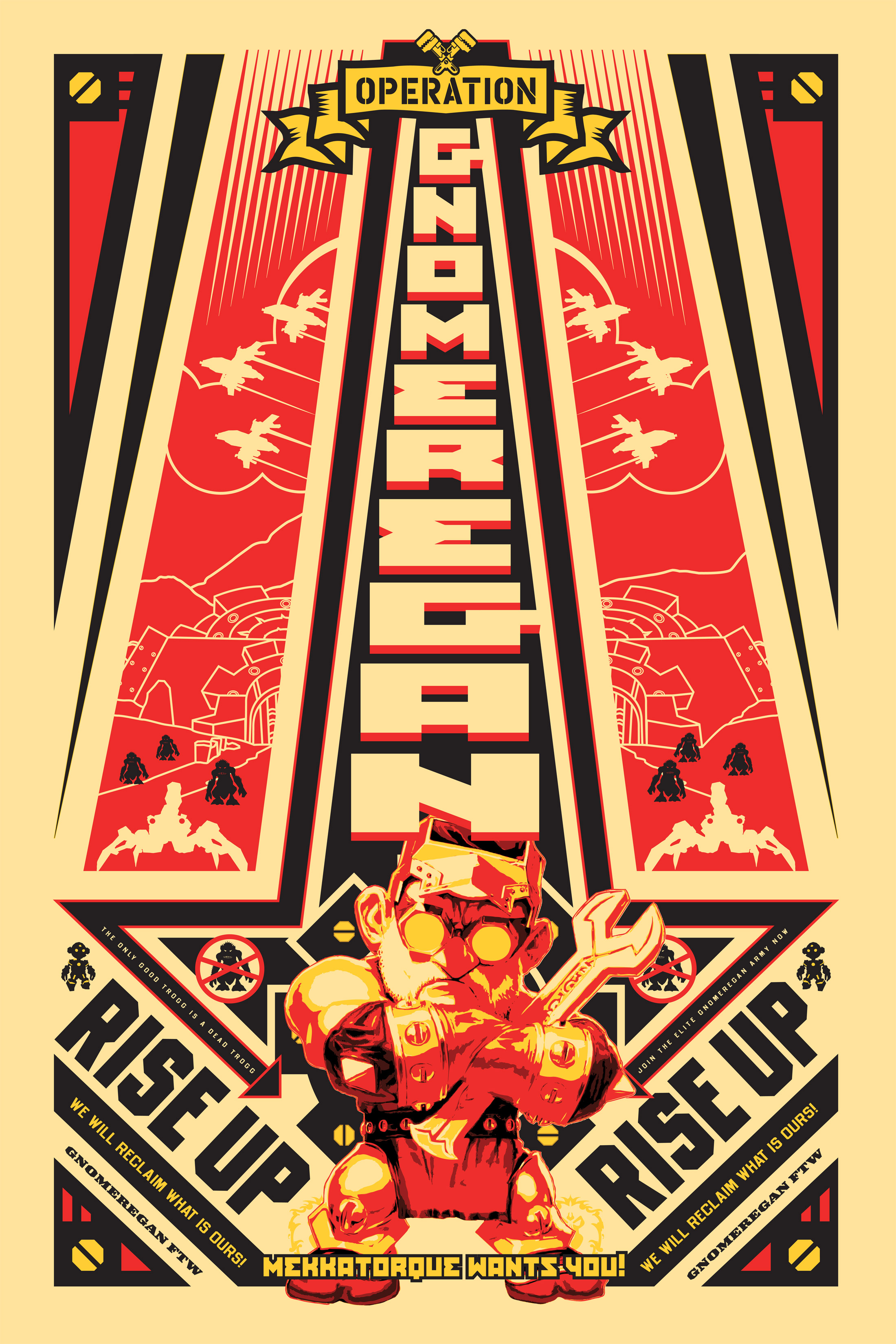
Operation: Gnomeregan - An absolutely wasted opportunity of storytelling on Blizzard's part.

(See the rest below the fold)

Friday, June 07, 2013

Return to Mar Tesaro - Misfire

Truth be told, the current campaign is actually my second attempt to run the Mar Tesaro setting again.  The first attempt failed through no fault of its own.  Like so many games before it, real life ended up getting in the way.  After the conclusion of a prior campaign, a number of people went on hiatus to spend time with their families, and one of the interim games became the reborn Mar Tesaro campaign.  We had about four sessions or so before the remainder couldn't spare the time to play.  By the time they were ready to play again, so was the rest of the group, and it was the consensus that starting fresh would be better in the end.

The short campaign that resulted ended up having little in common with the current campaign, although a large part of that was the result of being unable to introduce the larger themes and ideas right away.  I still think what resulted is interesting enough to write about.

The two characters in the group (and I must say that running D&D 4E for two people is really complicated) were Traster Dewshining, an eladrin* swordmage who survived the transition to the new campaign, and Dertritus Grubstake, a dwarf ranger with a huge spider companion.  Dertritus didn't make the transition, and I'm rather glad.  Why?  Well, here's his inspiration:
KILL. IT. WITH. FIRE.

Tuesday, June 04, 2013

Return to Mar Tesaro - The gods must be crazy

In the last installment of this series, I introduced the various factions that would be inhabiting Mar Tesaro for a new campaign.  I want to focus on the founding of the Council of the Nine, the organization of leaders from the major religions present on the island.  This group ends up becoming a major player in the campaign.  Before I can explain the Council, however, I need to talk about the first campaign.

When you run multiple campaigns out of the same setting, I imagine there's a lot of temptation to maintain a storyline for the setting.  Events from the previous campaigns become the stories and legends of the new campaigns.  PCs transition into important NPCs, historical or otherwise.  This can be satisfying for the GM because you're now telling one coherent story, which makes your setting deep and detailed.  Players, on the other hand, probably find this a bit obnoxious.  Homebrew settings can be a pain to learn already, but throwing in multiple campaigns worth of history can really complicate matters.  Add in NPCs who the GM favors, since they used to be PCs, and you can really alienate the players.

Still, the potential to tell an interesting story can make the effort worth it.  I might not have made my PCs from the first campaign part of the canon, had it not been for the actions of one elven cleric:  Amelia Lightfoot.
I'm assuming she's so happy because she just got out of her armor.  Artwork by Mario Pons.
(See the rest below.)

Thursday, May 30, 2013

Return to Mar Tesaro - Meet The Factions

When I first ran the Mar Tesaro campaign, there were a few major factions running around.  There were the three racial nations comprising the island:  Dwarf, Elf, and Human.  By the time my players showed up, the Elves were pretty much in control of everything, although with civil wars there can be significant lag time between the end of the war and various participants admitting it's over.  There was also the cult of Mordan, which played the active role of "bad guys" for the campaign.
Civil war doesn't seem quite as scary in comparison.
My goal for the return campaign was to have a much greater variety in the groups who made up the sociopolitical landscape.  I also wanted all of my players to be natives of the island, not visitors, so having a variety of factions for them to incorporate into their personal story would really help integrate the characters with the setting, as well as providing resources and contacts for the players.

Below is a list of the major factions I decided would be a part of the setting, as well as a brief description of each:

Friday, May 24, 2013

Return to Mar Tesaro - Setting the stage

When I was dreaming up the campaign that would bring players back to Mar Tesaro, my goal was to update the setting.  While I could always just run that same story again, it wouldn't really be mine.  I wanted to keep the island, keep the key events and characters, but move time forward so that it's effectively a different place.

In order to set the stage, it probably helps to look at the state of things when the first campaign ended.
War is hell.  Unless you're playing games.  
Then war is awesome.
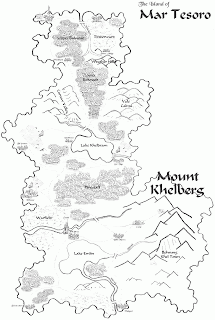
Mar Tesaro is an island nation with a lot of problems.  The most prominent feature of the place is a mountain that dominates the southeastern portion of the map, which is home to an overprotective nature spirit, Fiore.  Some time in the past, that spirit was locked away so that people could mine the vast deposits of gems and minerals from the mountain in a wrath-free environment.  Wars came and went as people fought over the mountain.  Eventually a lich took the throne and threatened the global balance of power.  Three nations (human, elf, and dwarf) came together to knock him off and took control of the island for themselves.  More wars came and went, this time of the internal variety.

When the first campaign started, the players were strangers to Mar Tesaro.  A civil war had just finished up, and the elves were the grand winners.  By the time the campaign had ended, the players had freed (and re-imprisoned) the lich-king Mordan (not to be confused with that other guy), released the trapped mountain spirit Fiore and restored balance to the force.  Well, most of the above.

Since I want to advance the setting several years after these events, what are the premises from that campaign?
  1. The primary economic engine for the island is now defunct. With Fiore released, it is no longer possible to mine any minerals or gems from the mountain.
  2. The military might of the island is mostly depleted.  The elven forces crushed the humans and kicked out the dwarves.  Then Mordan returned, taking a chunk out of what remained.  
Clearly, the victorious Queen Alessia has some issues on her hands.  So, what would any good leader in a fantasy setting do?  Hire adventurers.  (See the rest after the jump.)

Wednesday, May 22, 2013

Return to Mar Tesaro - Prologue

As I've said in previous posts, I've been running a Dungeons and Dragons campaign for the last several months.  Since writing typically helps me to organize my thoughts about topics, I thought it might be worthwhile to start a series on the setting of my campaign.

Back in 2006, I'd never played a tabletop RPG.  I was introduced to Shamus Young's website via his webcomic, which lead me to his synopsis of a campaign set on the island of Mar Tesaro.    Reading his stories made me want to try the games for myself, so I went to my friends with a proposal that we play D&D.  "Sounds great!"  they said.  "What are you going to run for us?"
Instant campaign.  (Some assembly required.)

This was a pretty daunting prospect.  It wasn't just that I hadn't played an RPG before, much less run one, or that I knew almost nothing about the game itself, but the fact was that I didn't really know what to do for a story.  I certainly wasn't about to write a new setting myself, and I didn't know anything about the established D&D settings like Forgotten Realms or Greyhawk.  Mar Tesaro, however, looked perfect.  I was familiar with it, there was just enough detail available to provide for a campaign, and the story was already provided; all I had to do was plug in my players.

I've written about how that campaign went.   In retrospect, I made a lot of "new GM" mistakes. I treated Shamus's campaign too much like a script rather than a guideline.  I expected my players to interpret the clues and come to conclusions the same way Shamus's players did, and that's really just asking for trouble.  With a few notable exceptions, I basically presented Shamus's setting with only the thinnest veneer of personal touches to it.  Half the time I used his NPC dialog verbatim.  This wasn't a sophisticated effort, but everyone cuts their teeth some way or another.

In the years since that game ended, I've learned a lot about the finer points of running and playing games, both from having more experience and from listening to others tell their stories.  One question I kept asking myself, though, was how to take that Mar Tesaro campaign and do it right, make it mine, apply all the ideas and lessons I'd absorbed since the first game.

Last year, my players returned to Mar Tesaro.  This series is going to be about how I turned that beginner's effort into a mature setting and story.