Showing posts with label Religion. Show all posts

Sunday, April 14, 2019

A Reflection for Holy Week

One of the interesting parts of parenthood has been exposure to children's bibles. I'm incredibly appreciative of authors who can distill the biblical stories into a form that grabs children's attention; the times I've attempted to read to my kids from the actual scriptures were over very quickly, toddler attention spans being what they are.

Yet, for the variety of bible story books we have, there's a particular trend that jumped out at us:

When telling the story of Jesus, many of these books go from the Triumphal Entry straight to the Resurrection.

There's a sense in which this is perfectly understandable. It would be irresponsible not to curate the content of scripture to your child's maturity level. A pre-schooler is probably not ready to hear about Sodom and Gomorrah, David and Bathsheba, the book of Judges . . . take your pick.

Still, while I certainly wouldn't show my children Passion of the Christ, there are ways to explain the death of Jesus in an age appropriate manner. We have enough books which manage to do so.

Note the page numbers
Perhaps the issue isn't with the children, then, but with the adults. So many of us don't hide the crucifixion only from our children. We live out a faith that treats it like an embarrassment, or perhaps a temporary bump in the road. A necessary evil to get to the good part.

We admire Jesus the teacher, dispensing timeless wisdom about good morals and better living from the hillside. Jesus, meek and mild, caring for children, feeding the hungry, healing the sick, champion of the downtrodden . . . a paragon of idyllic goodness.

We like the picture of Jesus in the triumphal entry: The king coming into his city! See how his lordship is proclaimed and celebrated! Yes, there is always the shadow of betrayal right around the corner, but for a brief period of time, everything is as it should be, and will be again.

To be fair, Jesus's death does not go unmentioned, but it is certainly over before it began.
We love the Jesus of the resurrection. If death is the oldest enemy of mankind, then God has shown that it can be overcome. The power of God on display for all to see, the promises of ages fulfilled, the new creation set into motion!

Yet in a theology that lacks the crucifixion, we are left with a single question: Why?

I've heard so many sermons over the years talk about our need for Jesus. In trying to explain why you should follow the way of Christ, the preachers would say things like, "Because he is Lord and the resurrection proves it! Because his way is better than man's way! Because your life will be so much better with Jesus!" It's all true, but it's incomplete. It skips over something crucial.

We are lost in our sin. By ourselves, on our own, through our own means, we cannot be right before God. To fulfill the Law, to atone for our sins, to provide a righteousness isn't our own, Jesus came to take the penalty of sin on our behalf. It was our sin, my sin, and the mercy of God, that led Jesus to the cross.

We dare not pass over that too quickly.

Lent, as part of the liturgical calendar, is a time of preparation for Easter. It's not terribly popular with Evangelicals, for various reasons. As a historical practice, Lent has changed much over the centuries. Although it has always been a period of fasting, it was also a season of repentance. In order to prepare for the celebration of the Resurrection, of our freedom from bondage, we must first pass through the desert of remorse, culminating on Good Friday where we remember the work of the Cross.

This isn't guilt-stricken self-flagellation, because Christ has already received our punishment. Instead, sober awareness of the state from which Christ has saved us. The scriptures promise that we are no longer in bondage to sin (see Romans 6). There is, after all, no longer an condemnation for those in Christ. The good news of the Gospel will always fall flat if we don't know how much God has done for us, and we can't know that without seeing just how great our need is.

Wednesday, October 18, 2017

Book Review - Allah: A Christian Response

You might remember that last year I wrote reviews of books by Nabeel Qureshi. The latter review of No God But One covered a crucial topic for Qureshi: Are Islam and Christianity really all that different?

A friend of mine suggested my next book be Miroslav Volf's Allah: A Christian Response. In fact, he actually bought the book for me; thanks again, friend. 

I think understanding this book starts with understanding the author. Volf's Wikipedia page carries a lot of noteworthy accomplishments and glowing references. Theologian, seminary professor, author, public intellectual, White House advisor . . . the man has a long and reputable résumé. There is a strong theme throughout his work, however, of interfaith engagement, the most relevant work being his crafting of the "Yale Response" to "A Common Word.

This book seems to have been an outgrowth of that work, though in this case, Volf's audience is fellow Christians, or at least that's what he claims in the book. The central question Volf seeks to answer in Allah is, "Do Christians and Muslims worship the same God?" Nabeel Qureshi answered the question in the negative. Volf, in the course of the book, says, "Yes, we do worship the same God." (If you're interested in hearing these two debate the matter, there's audio of just that.)

Volf spends a lot of time laying his groundwork, but his basic argument follows that of "A Common Word," arguing that Muslims and Christians worship the same God because of their common ground, a faith centered in the love of God and the love of neighbor. He spends a great deal of the book unpacking these ideas. 

I really struggled to finish this book. My first inclination while reading it was to call Volf a hack. That isn't fair or charitable, but it was born out of irritation, and a sense, as I worked my way through the chapters, that Volf was not dealing with the topic in an honest manner. I can't know the process by which Volf reached the conclusions he did; I can't unpack the people he's met or the books he's read. However, I can at least respond to the arguments he's made, and they are not convincing, as far as I'm concerned.

Monday, December 12, 2016

Chasing the Wind: Of Pain and Sovereignty

In my last entry of the series, I didn't dwell on the text of Ecclesiastes in order to present some arguments that I'd need to return to later. In retrospect, my discussion on God's sovereignty would have been all the better for consideration of the following text, although it was already lengthy enough. My purpose last time was addressing the criticism that our actions and lives cannot be meaningful if they cannot actually change the outcome. God's sovereignty, in that consideration, prevents us from having Meaning because nothing we do matters.

Although I did address this argument, it turns out there's another aspect of God's sovereignty which weighs on the heart.
For everything there is an appointed time, and an appropriate time for every activity on earth: 
A time to be born, and a time to die;
     a time to plant, and a time to uproot what was planted;
A time to kill, and a time to heal;
     a time to break down, and a time to build up;
A time to weep, and a time to laugh;
     a time to mourn, and a time to dance.
A time to throw away stones, and a time to gather stones;
     a time to embrace, and a time to refrain from embracing;
A time to search, and a time to give something up as lost;
     a time to keep, and a time to throw away;
A time to rip, and a time to sew;
     a time to keep silent, and a time to speak.
A time to love, and a time to hate;
     a time for war, and a time for peace. 
What benefit can a worker gain from his toil?  I have observed the burden that God has given to people to keep them occupied. God has made everything fit beautifully in its appropriate time, but he has also placed ignorance in the human heart so that people cannot discover what God has ordained, from the beginning to the end of their lives.
I have concluded that there is nothing better for people than to be happy and to enjoy themselves as long as they live, and also that everyone should eat and drink, and find enjoyment in all his toil, for these things are a gift from God. 
I also know that whatever God does will endure forever; nothing can be added to it, and nothing taken away from it. God has made it this way, so that men will fear him. Whatever exists now has already been, and whatever will be has already been; for God will seek to do again what has occurred in the past. - Ecclesiastes 3:1-15 (NET)

Monday, September 26, 2016

Chasing the Wind: Our Story

I mentioned in the first entry for this series that I've been re-reading some philosophy books. In A.J. Ayer's essay, The Claims of Philosophy, I came across this paragraph:
But for now, it may be objected, suppose that the world is designed by a superior being. In that case, the purpose of our existence will be the purpose that it realizes for him; and the meaning of life will be found in our conscious adaptation to his purpose. But here again, the answer is, first, that there is no good reason whatsoever for believing that there is any such superior being; and, secondly, that even if there were, he could not accomplish what is here required of him. For let us assume, for the sake of argument, that everything happens as it does because a superior being has intended that it should.
 . . . The point is, in short, that even the invocation of a deity does not enable us to answer the question why things are as they are. 
I've left out the details of the argument, and Ayer goes on like this quite a bit more; Kai Nielsen repeats Ayer's argument in his essay, Linguistic Philosophy and "The Meaning of Life." (I don't recommend the latter. Linguistic Philosophy, as a field, seems like endless pontification on what the meaning of "is" is with the assumption that such navel gazing is profound.) There's much to say in response to this line of argument, but it becomes easier to do so in the context of the Christian world view. In other words, the response to all of these different formulations and perspectives on Meaning becomes understandable in the light of the story Christians tell about the Meaning of Life.

Maybe this comes off as surprising to some. Christians have an answer to the question of Meaning? What is the Christian answer here?

We were made to be in relationship with God.

Does that seem too simple? It really isn't. To make the most sense of this, we have to go back to the beginning. Before that, really.

Thursday, August 25, 2016

Book Review: No God But One

A few months ago, I received a copy of Answering Jihad: A Better Way Forward for review. Written by Nabeel Qureshi, it was a brief examination of jihad in Islam and the Christian response to it.

I was fortunate enough to receive a review copy of Qureshi's third book, No God But One: Allah or Jesus? as well. If his first book, Seeking Allah, Finding Jesus, was the story of how his heart changed in his conversion from Islam to Christianity, then No God But One is the story of how his mind changed.

In No God But One, Qureshi takes the time to unpack two primary questions central to someone seeking to know God:
  1. Are Christianity and Islam really all that different?
  2. Can we know whether Islam or Christianity is true?
These are both questions of profound importance. There is no sense in choosing between one faith or the other if they are not meaningfully different, but if they are different, then how can you know which one to choose? This is not a process of elimination, either; they must stand or fall on their own merits. As Qureshi says of his own experience:
For me, it's been a decade since I made the decision to leave Islam, and the fallout of my decision haunts me every day. I knew it would, well before I ever converted, but I also knew that I was sure. I was sure that Islam and Christianity are not just two paths that lead to the same God, but two very different paths that lead very different ways. I was sure that I had excellent historical reason to believe the gospel. I was sure that, though I loved Islam, I couldn't ignore the problems that plagued its foundations. But most of all, I was sure that following the one true God would be worth all trials and all suffering. I had to follow the evidence and the truth, no matter the cost.

Friday, August 12, 2016

Chasing the Wind - A Legacy of Knowledge

A while back, Neil DeGrasse Tyson was speaking in front of an audience, and was asked, "What is the meaning of life?" This was his answer:
So — what is the meaning of life? I think people ask that question on the assumption that 'meaning' is something you can look for and go, 'Here it is, I found it. Here's the meaning. I've been looking for.' That scenario, however, doesn't consider the possibility that 'meaning' is something you create. You manufacture it for yourself and for others. 
So when I think of 'meaning' in life, I ask, 'Did I learn something today that I didn't know yesterday, bringing me a little closer to knowing all that can be known in the universe?' If I live a day and I don't know a little more than I did the day before, I think I wasted that day. So the people who, at the end of the school year, say 'The summer! I don't have to think anymore!' — I just don't know. To think brings you closer to nature. To learn how things work gives you power to influence events. Gives you power to help people who may need it — to help yourself and your trajectory. 
So when I think of the meaning of life, that's not an eternal and unanswerable question — to me, that's in arm's reach of me everyday. So to you, at age six-and-three-quarters, may I suggest that you explore nature as much as you possibly can. And occasionally that means getting your clothes dirty because you might want to jump into puddles and your parents don't want you to do that. You tell them that I gave you permission.
His questioner was six years old, so you can see how this is an answer for a child on some level. He might just as well have added, "Eat your veggies and drink your milk." You can also see the post-modern perspective in there as well, replacing Meaning with "meaning," where "Whatever gets you through the day" is meaningful. To each his own, etc. I'll have to address that another day.

All the same, Tyson is a scientist (well, depending on who you ask), and this is definitely a scientist's answer on the question of Meaning.

Tuesday, August 02, 2016

Chasing the Wind

I've been working on one of those "Read the Bible in a year" plans for ... well, for a while now. I might finish it at some point. Earlier this year, I found myself in the book of Ecclesiastes. It's not a book most people are familiar with; after all, it's the Wisdom Book that isn't Proverbs, and much of what it says comes off as strange, to say the least.

Yet, after reading it, I went back and read it again. Then a third time. Something about this was really sticking in my mind for some reason. Why was it so familiar?

It took a while to hit me: Ecclesiastes is a philosophical text about the Meaning of Life.

Saturday, March 12, 2016

Book Review: "Answering Jihad: A Better Way Forward"

As I said before, I received a review copy of Nabeel Qureshi's latest book, Answering Jihad: A Better Way Forward several weeks ago. I shared a few thoughts on the book then, but I have much more to say now.

Although Qureshi converted to Christianity several years ago, the "question" of Islam and Muslims is no less important to him. As he puts it, "Ignoring the reality of jihad endangers my nation, while responding with fear endangers my Muslim family." Helping others to understand the "how" and "why" of Islamic radicalization isn't just a religious conviction, but a deeply personal matter as well, and it shows throughout the book.

The book is divided into three parts, each addressing a general area of inquiry: The origins of jihad, jihad today, and jihad in the Judeo-Christian context. Each of these sections is then further divided into "Questions," wherein each chapter addresses a specific issue. This makes it possible to jump directly to subjects of interest, such as, "Why are Muslims being radicalized?" or "Does Islam need a reformation?" I still found it most useful to read straight through; Quereshi does a wonderful job explaining the subjects in his particular style, and he builds on each successive topic through the book. You may or may not agree with his answers on some of the Questions, but reading everything will certainly help in understanding how he came to the conclusions he reaches.

It's worth reiterating that the book was written as a primer on these things. Each Question could itself be the subject of a book. One does get the impression of only scratching the surface in each chapter, but Qureshi recommends further resources throughout the book.

Sunday, February 28, 2016

Book Preview: "Answering Jihad: A Better Way Forward"

I've got a review copy of a book, so some of you might find this interesting.

Two years ago you might have seen Nabeel Qureshi's book Seeking Allah, Finding Jesus. If you didn't read it, it was an American Muslim's story of finding Christ by trying to commit himself to Muslim Apologetics. Quereshi graduated medical school, but took up the path of Christian apologetics afterwards. In the entirety of his time doing so, he's been getting lots of questions about jihad and radical Islam. Apparently he's been rather demure on the topic, because it's kind of a hot issue.

The tumult of the last year was evidently too much for him, and he decided to take up the topic in writing. In fact, he wrote a book on it in three weeks, Answering Jihad: A Better Way Forward.
But was it true? After years of investigation, I had to face the reality. There is a great deal of violence in Islam, even in the very foundations of the faith, and it is not all defensive. Quite to the contrary, if the traditions about the prophet of Islam are in any way reliable, then Islam glorifies violent jihad arguably more than any other action a Muslim can take. - My Fork In The Road - An excerpt from Answering Jihad.
Qureshi's target audience for this is Christians, but some of the material could be useful to wider audiences. The book is presented in three parts. In the first part, he discusses the nature and historical basis for jihad, how it relates to the Quran, the Hadiths, and Muhammad's life. In the second part, he talks about the modern development of radical Islam and the basis of Islamic violence, both against the West and against fellow Muslims. In the third part, he explores jihad in the Juedo-Christian context: Whether Muslims and Christians worship the same God, comparing the teachings of Jesus to those of Muhammad, Old Testament warfare in comparison to jihad, and so on.

The conclusion to the book, though, is a call to answer jihad the way Jesus would have: In love, even a self-sacrificing love.

I enjoyed it, although it was a very fast read. Qureshi admits the book is a primer, and he does recommend resources throughout for exploring certain topics in greater depth. Still, if someone wanted a book with good answers for various questions about Islam, radical Islam in particular, the book would be a great resource.

The book is only available for pre-order at the moment, but if you pre-order the book, you get access to bonus materials, including videos of Nabeel discussing various chapters of the book in greater depth.
This conclusion led me to a three-pronged fork in the road. Either I could become an apostate and leave Islam, grow apathetic and ignore the prophet, or become “radicalized” and obey him. The alternative of simply disregarding Muhammad’s teachings and continuing as a devout Muslim was not an option in my mind, nor is it for most Muslims, since to be Muslim is to submit to Allah and to follow Muhammad. Apostasy, apathy, or radicalization; those were my choices… - My Fork In The Road - An excerpt from Answering Jihad.
Later on, I'll have a full review of the book here, but for now you can (and should!) explore the Answering Jihad website for more info on the book.

Monday, June 29, 2015

Paul vs. Jesus

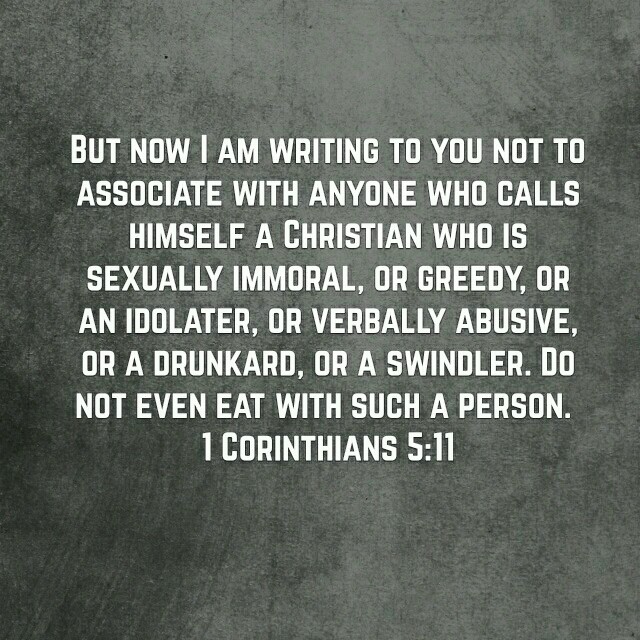
Earlier today, I posted this to my Facebook account:
Made with the Bible app YouVersion. What interesting times we live in.
I posted it because, well, Paul doesn't mince words. American culture tends towards the milquetoast, especially when it comes towards criticizing someone else's behavior, but Paul was unabashed in his criticism of the church at Corinth.

Verses like this aren't very popular. It's not the warm, fuzzy face of Christianity. It warrants difficult decisions. It's problematic, especially in a world where we'd like to get along with people who we'd really like to reach with the gospel, and they don't appreciate all this talk about sexual immorality. "Why can't people be nice, like that Jesus was? Jesus loved everyone. He's the one Christians worship anyhow, right? Who cares about this Paul guy? " It's not a new criticism, but it does deserve consideration. Although as I see it, it's actually two different arguments that need to be addressed:
  • Shouldn't Jesus be given primacy over Paul?
  • Jesus loved the sinners in his midst; so why are Christians so hung up on sin?
"Let the one who boasts, boast in the Lord."

The funny thing about this first argument isn't that it was addressed ages ago, but that it was Paul himself who did so. 
Now I mean this, that each of you is saying, “I am with Paul,” or “I am with Apollos,” or “I am with Cephas,” or “I am with Christ.” Is Christ divided? Paul wasn’t crucified for you, was he? Or were you in fact baptized in the name of Paul? . . . What is Apollos, really? Or what is Paul? Servants through whom you came to believe, and each of us in the ministry the Lord gave us. I planted, Apollos watered, but God caused it to grow. So neither the one who plants counts for anything, nor the one who waters, but God who causes the growth. . . . So then, no more boasting about mere mortals! For everything belongs to you, whether Paul or Apollos or Cephas or the world or life or death or the present or the future. Everything belongs to you, and you belong to Christ, and Christ belongs to God. - 1 Corinthians 1:12-13, 3:5-7, 3:21-23
Paul was addressing divisions within the church at Corinth, but he certainly didn't understand himself  to have been preaching a different gospel than the one Jesus taught. Nor did the apostles who formed the church in Jerusalem and interacted with Paul frequently over the years.* Nor did the early churches which circulated copies of Paul's letters. Nor did the ecumenical councils which established the canon of the New Testament.

Ignoring any issues about authority or canonicity, was Paul actually being harsh where Jesus was lenient? Was he holding people to a higher standard than the actual Messiah? 

"And you are proud!"

Paul wasn't just addressing divisions and factions within the church of Corinth, but deep misunderstandings about sin and Christian living. 
It is actually reported that sexual immorality exists among you, the kind of immorality that is not permitted even among the Gentiles, so that someone is cohabiting with his father’s wife. And you are proud! Shouldn’t you have been deeply sorrowful instead and removed the one who did this from among you? - 1 Corinthians 5:1-2
It's not clear from the text why they were proud of this; in 6:12, Paul addresses popular sayings of the Corinthians in an effort to correct them. It's plausible that the particular group being addressed here had a rather exaggerated sense of "Christian freedom" to the point that they were inviting scandal and celebrating their ability to sin so freely. 

In chapter 5, Paul is exhorting the church that letting sin fester in its midst is harmful. Like an infection, it can spread and cause misery throughout the entirety of the church. Thus, deliberate, ongoing, unrepentant sin shouldn't be tolerated in their midst, but be removed from fellowship.

To come back around to the argument at hand, people like to imagine that Jesus was not judgmental, not like this. Except:
If your brother sins, go and show him his fault when the two of you are alone. If he listens to you, you have regained your brother. But if he does not listen, take one or two others with you, so that at the testimony of two or three witnesses every matter may be established. If he refuses to listen to them, tell it to the church. If he refuses to listen to the church, treat him like a Gentile or a tax collector. - Matthew 18:15-17
Paul is echoing Jesus's specific directive here. As he makes clear, he's already written to them about avoiding sexual immorality, and this scandal was apparently so notorious that word of it had spread to Paul from beyond the city of Corinth; it was likely part of the reason for division within the church. Jews did not associate with Gentiles, and tax collectors were seen as Roman sellouts, so Jesus was not advocating familial responses to fellows who refused to stop sinning. Jesus may have kept company with the disreputable, but the message here was clear: If someone within the church acts like someone outside the faith, you treat him like someone outside the faith. 

None of this is to say that the church which casts this fellow out is perfect. Both Paul and Jesus recognize the struggle with sin and temptation. Still, it is one thing to wrestle with sin, and another to wallow in it. 

Even so, perhaps Paul is still too harsh. After all, Jesus was silent on a number of subjects, and he didn't talk about sexual sin too frequently. He preached against divorce and adultery, but that was it, right? If Jesus isn't all hung up on sex, why should we let Paul get away with it?

The problem is, Jesus set a high bar for sexual sin.
“You have heard that it was said, ‘Do not commit adultery.’ But I say to you that whoever looks at a woman to desire her has already committed adultery with her in his heart. - Matthew 5:27-28
Jesus makes it clear in his teaching, it's not just about actions, but what is in the heart. It is, after all, "deceitful above all things." (Jeremiah 17:9)

Fine, but that's just for adultery. Did Jesus preach about any other forms of sexual sin? Yes, as it turns out:
Then he called the crowd to him and said, “Listen and understand. What defiles a person is not what goes into the mouth; it is what comes out of the mouth that defiles a person. . . .  But the things that come out of the mouth come from the heart, and these things defile a person. For out of the heart come evil ideas, murder, adultery, sexual immorality, theft, false testimony, slander. These are the things that defile a person; it is not eating with unwashed hands that defiles a person." Matthew 15:10-11, 18-20
That term, sexual immorality, is one Paul uses as well. It is often translated as "fornication," understood as sex between unmarried individuals. 

As for other sexual sin, talk of homosexuality never appears in any of the gospels, it is true. A full explanation of why this is irrelevant is too much for this post; consider the arguments being addressed here, here, here, or here, just as a start. Suffice it to say that no first century Jew would have understood homosexuality as anything other than a sin due to Levitical teaching, and it would have gone against the entirety of a scriptural understanding of the nature of marriage and sexuality as given by God; Jesus didn't preach about it much because his ministry focused almost entirely on Israel, where (presumably) homosexuality wasn't up for debate.

Jesus runs with a bad crowd

Even so, Jesus did hang out with sinners. It was a charge repeated by his critics multiple times. These weren't purely social visits, however. When Jesus taught, he called these people to repentance.
When the experts in the law and the Pharisees saw that he was eating with sinners and tax collectors, they said to his disciples, “Why does he eat with tax collectors and sinners?” When Jesus heard this he said to them, “Those who are healthy don’t need a physician, but those who are sick do. I have not come to call the righteous, but sinners.” - Mark 2: 16-17
We don't often know how these dinners with sinners played out, but we can assume Jesus did not treat the conversation lightly. Consider how things turned out for Zaccheus:
And when Jesus came to that place, he looked up and said to him, “Zacchaeus, come down quickly, because I must stay at your house today.” So he came down quickly and welcomed Jesus joyfully. And when the people saw it, they all complained, “He has gone in to be the guest of a man who is a sinner.” But Zacchaeus stopped and said to the Lord, “Look, Lord, half of my possessions I now give to the poor, and if I have cheated anyone of anything, I am paying back four times as much!” Then Jesus said to him, “Today salvation has come to this household, because he too is a son of Abraham! For the Son of Man came to seek and to save the lost.” Luke 19:5-10
Compare that to the Pharisees. Jesus reserved some of his harshest language for these men. They were also called to repentance, but their response to Jesus was considerably less enthusiastic.

Paul the father

In the end, Paul didn't write the verse in question above, or any of the first letter to the church at Corinth, out of animus or hatred. He did so out of love.
 I am not writing these things to shame you, but to correct you as my dear children. - 1 Corinthians 4:14
Paul loved the Corinthians, as he loved every church he planted or visited along his travels. He only wanted what was best for them. Knowing how destructive sin could be if left unchecked, he urged them to remove it and spare themselves any further consequences from sin.

Paul's advice is specifically for the church, too. Expanding the original quote:
I wrote you in my letter not to associate with sexually immoral people. In no way did I mean the immoral people of this world, or the greedy and swindlers and idolaters, since you would then have to go out of the world. But now I am writing to you not to associate with anyone who calls himself a Christian who is sexually immoral, or greedy, or an idolater, or verbally abusive, or a drunkard, or a swindler. Do not even eat with such a person. For what do I have to do with judging those outside? Are you not to judge those inside? But God will judge those outside. Remove the evil person from among you. - 1 Corinthians 5:9-13
In Matthew 18, Jesus makes clear that the course he is laying out is for those within the fellowship of the faithful. What would bringing the person to the church mean otherwise? The command is not to disassociate from sinners in the world; how else can we reach them? It is also not for those who struggle with their sins and temptations. Indeed, in the very same chapter, Jesus tells Peter to forgive his brethren not seven times, but seventy times seven times. (Matthew 18:21-22)

No, this advice is for the church in dealing with those who remain in sin, deliberately returning to it, celebrating it, exulting in it. It is for the church in addressing those in its midst who would put their sin on display for the world to see, refusing to turn from, apologize for, or make amends for it.
*I find it deeply amusing that Paul is often criticized as being too strict or harsh compared to Jesus, when Peter and the other apostles in Jerusalem thought that Paul was too lenient. After all, he was baptizing all these Gentiles without first having them follow the Mosaic law. Quelle horreur!

Friday, February 20, 2009

Celebrity

I've said for a while now that I think Obama's popularity is driven by a "cult of personality," or perhaps a "cult of celebrity." Either way, I tend to think that there's a lot more at work behind this than people thinking his policies are super-duper.

The response I tend to get from liberals to this range from, "Nu-uh," to, "You're just jealous 'cause you lost." Perhaps. Then again, when I see stuff like this, I can't help but feel vidicated. I'll include a screencap in case it goes away.

Wednesday, February 18, 2009

Pelosi and the Pope

Not a news story per se, but I enjoy this National Review post discussing Nancy Pelosi's recent visit to the Vatican. The short version is that the Pope gave her (and by extension, all pro-choice Catholic politicians) a dressing down for supporting abortion.

While it's no secret that I disagree with Catholic theology (one of these days we'll finish a conversation, Ryan) on everything that separates them from Protestants, I appreciate that the Pope doesn't pull any punches on this issue. In the structure of the Catholic church, there is no room for "disagreement" on issues like this. If you're going to claim the church as your own, you have some requirements to meet. I think that the broader Christian church is the same in principle, though there's obviously no central power structure for enforcement. Not that we've seen any pro-choice Catholic politicians excommunicated recently.

I must disagree with the author of this on one point, however. He states that politicians like Pelosi are where they are because they're poorly catechized, getting their teachings from high-brow Catholic intellectuals who don't want to deal with "embarrassing" teachings. I can't give them this much leeway. The teachings of the Catholic church are accessible enough that there should be no mystery on what it really teaches. For crying out loud, Pelosi just got it from the horse's mouth (so to speak). If she suddenly changes course and becomes a pro-life politician, I'll offer up a heartfelt apology, but I doubt she, nor any other pro-choice Catholic politician, is going to change anytime soon. These people hold onto their religious affiliation, I suspect, out of political expediency, even necessity, rather than any heartfelt conviction. Perhaps it's the cultural identity that they desire instead. Either way, there is no other explanation for people who claim a title while denying its most important or relevant teachings.

Saturday, December 20, 2008

Know your stuff

A new Pew survey was recently released, and the results are very strange. Apparently, a large number of Christians (half in evangelical churches and more than that in other Christian groups) believe that there is more than one way to heaven. The link leads to Dr. Mohler's analysis of the story, and he has some more details as well as links to the Pew data.

Furthermore, in this data is that these people who say that there are other ways to heaven say that the groups of non-Christians who get to go to heaven will do so by their good works.


I realize it can be a little awkward to tell somebody, "I believe that you'll go to hell if you don't change your faith," but this clearly isn't the answer. I can understand this coming from mainline Protestant groups, as they have been trending away from respect for the text for some time now. I can understand this from Catholics, as their theological leadership often seems more inclined to play politics with the other faiths of the world than actually stick to their guns.

But evangelical churches? This is oddball stuff for evangelical Christians. So where is it coming from? A desire to be "polite" in mixed company and not be "offensive?" Poor teaching from the pulpit? A trendiness in taking the title of "evangelical" without actually caring about the beliefs?

It's hard to say. But I will offer this to any of the Christians out there who want to say that there is more than one way to heaven: You can only reach this conclusion by actively ignoring the Biblical text. If you're going to believe as you do, then you either have to offer up a compelling reinterpretation of those verses or explain why those verses can be ignored.

Tuesday, December 09, 2008

Newsweek on Gay Marriage

I share Dr. Mohler's amazement that a reputable news magazine would put what is clearly an op-ed as its cover story. Priorities, I suppose.

The entire article is about the religious argument in relation to gay marriage, and how, according to author Lisa Miller, the Bible cannot be used to condemn it but rather to support it. There are so many things to unpack in her article I scarcely know where to begin. I could go through every paragraph in the article and find something wrong, but instead I'll try to hit the broader points and categorical mistakes.

First, Miller wants to argue that the Bible's lack of prohibition on polygamy means that it says nothing normative on marriage. We'll skip past that for now because I don't think arguing about Old Testament rules on polygamy really adds to anything here, but there's one small problem for her in this: Even if you accept that the Bible is okay with polygamy, how does this translate to acceptance of homosexuality and gay marriage? The polygamous marriages described in the Bible were always heterosexual. It's a logical fallacy to say, "You're wrong, therefor I am right." The two can be mutually exclusive.

Next, Miller wants to argue that Biblical prohibitions and condemnation of homosexuality either isn't what it says it is or is no longer authoritative. She hits this from both the Old Testament (with the Levitical injunction against homosexuality) and the New (with Paul's condemnations against it, too). The OT argument is an old one, which I won't rehash here for sake of space. I will, however, ask a question: If Old Testament rules are no longer in force because they're "outdated," how do you decide which ones to follow and which ones to ignore? I'd say that answering that question is important to understanding Biblical interpretation, and critical to arriving at the question of the morality of homosexuality.

As for Paul, she writes that Paul was merely condemning the excesses of sinful Nero or Caligula, though she doesn't really get into why he would mention the homosexuality if he didn't think it was sinful. There's also the old argument that, in Romans 1, Paul is condemning those heterosexuals who practice homosexuality, not homosexuals just being themselves.

The problem with both of those arguments is that it ignores Paul's talk of homosexuality elsewhere in the New Testament, such as in 1st Corinthians 6. There, Paul describes those who are "unrighteous." He lists two groups, both of them homosexuals. In the greek, there are actually two words for homosexual: The one who "received" and the one who "gave" (and I'll leave the description at that). Paul condemns both, which ought to drive home the idea that it's the act itself that is singled out as sinful, not any particular mindset going into it.

Third, Miller argues that Jesus rarely talked about marriage and never about homosexuality, so clearly it's not an issue. This is, once again, an old fallacy: Jesus didn't discuss X, so X is not sinful. We don't know all the details about Jesus's ministry, so it's possible that he did discuss the issue at some point and it's lost to history as to what he said. However, considering his support of the law and for the unity of man and woman in marriage, I doubt he would have had much positive to say about homosexuality. Even that aside, Jesus came to Earth with a rather specific purpose and a rather specific message. His goal was not to reinforce Jewish law or to tell everybody how to live, how great brotherly love is, and how it'd be really nice if people would start getting serious about showing up at the Temple again. Jesus came to prepare the world for what was a major change in God's relationship with mankind; Jesus came to announce the solvation of the old covenant and the coming of the new covenant, to call people to redemption and to prepare them to understand just what his life and death (and life again) would mean.

I'll even toss in here her mentioning of Paul's singlehood, with his wish that everyone else could "be as [he] is." The thing is, Paul offers this up not as a "command from the Lord" but as his own personal advice. Paul's bachelor status meant that he was able to spend his life travelling the world and spreading the gospel. Paul only wishes that everyone else could take part in such a lifestyle! But Paul also acknowledges that everyone has different callings from God on their life, and that some people will inevitably marry. Again, I don't see how this equates soft support for gay marriage, as Miller does.

Finally, I just want to address the overall problem Miller seems to have in this. She makes a lot of statements that reveal the overall problem:
  • "Biblical literalists will disagree, but the Bible is a living document, powerful for more than 2,000 years because its truths speak to us even as we change through history."
  • "But . . . if you believe that the Bible was written by men and not handed down in its leather bindings by God . . ."
  • "A mature view of scriptural authority requires us, as we have in the past, to move beyond literalism. The Bible was written for a world so unlike our own, it's impossible to apply its rules, at face value, to ours."
At the root of this is the fundamental question of what the Bible is, who wrote it, and from where its authority comes. If you believe that the voice of God cannot be distinguished from the voice of men in the text, then how do you distinguish which parts of the text are still authoritative? If it's all just a matter of what "speaks to us" at this stage of history, then does one decide what is from God and what isn't?

No, this is an old argument, wherein Biblical passages are considered "out of date" and simply tossed aside. The problem is that this is theology by popularity; if enough people get together and decide they don't like verse X anymore, then let's just ignore it! God is speaking to us and telling us that we need to "move past" such outmoded thinking.

Miller goes on and on about the Bible's passages on love, inclusion, and acceptance, but she ignores a critical element of it. True Biblical love does not ignore sin. It does not accept it, it does not explain it away, it does not excuse it, it does not look past it. True Biblical love confronts sin directly, as Jesus died as the payment for our atonement. As such, everyone is eligible for inclusion in the new covenant, but there's a catch: Participation in the covenant means acknowledging your sin and repenting of it (that is, leaving it behind). The Christianity Miller rails against is very inclusive; she just wants them to change their definition of sin.

Thursday, October 23, 2008

Why a pro-life person can't vote for Obama

This is related to my post below. The Hot Air piece did include a section on abortion. However, this is a much more comprehensive article on that subject in itself, so it's a must read if you consider yourself pro-life and are considering voting for Obama this year.

The most eye-catching indictment is that Obama intends to sign the freedom of choice act as soon as he's in office, which would make abortions a right in federal law, provide public funds for abortions (though public health aid), and remove conscience clauses that allow physicians and nurses to opt out of such procedures on moral grounds.

There's lots more, including analysis both on what he would do as president and what he has already done as a senator (state and national).

The bottom line is that Obama is in no way, shape, or form a pro-life candidate. If that platform is important to you, then there is no justifying a vote for him.

Tuesday, September 30, 2008

Missing Something

You may not know this, but people are celebrating Rosh Hashanah right now. I wouldn't have known, except we had classes cancelled for today and tomorrow. I guess there were enough jewish people involved with the course that they saw fit to cancel classes.

Apparently, during Rosh Hashanah, one is prohibited from doing any work that was done in the tabernacle. I'm not sure who's in charge of the modern day interpretation of this, but last night my neighbors asked me if I could turn off their alarm clock for them, as they weren't allowed to. They even panicked when I left a lightswitch on in their bedroom, as that's another bit of "work" they can't do either.

Let's leave aside any theological disagreements I might have with such practices. I found this to be something quite startling all the same. These people care so much about honoring God that they had to ask their neighbor to turn off their alarm clock for them.

When I think about a lot of people in the modern church, including myself, I have to wonder whether there is that level of dedication, whether we are too permissive. Do we consider holiness that important? What would it look like if we did?

I guess the whole affair left me with more questions than answers.

Thursday, June 26, 2008

Labels

Sometimes I despise post-modern America, where labels mean whatever you want them to mean. Oh sure, that's not universally true. I could call myself a lesbian, but most people would just look at me like I was a certified whacko. Still, there are areas where this seems to flourish, and it drives me batty.

Here's what I'm getting at: The Pew Forum recently released the data for the second part of their Religious Landscape survey in America. One of the most disturbing aspects, at least to me, involves self-identified Evangelical Christians. When asked whether their religion was the only way to heaven (a central dogma in Christianity), 57% said no. Fifty-seven percent! That means that at least half, if not more, of all self-identifying Evangelical Christians don't even understand what it means to be Christian! Is it any wonder that American Christianity sees such decline?

Of course, such silliness is not limited to Christians, either. Apparently 5% of atheists believe in God. Seriously? This word you keep using, "atheist" . . . I don't think it means what you think it means.

Sunday, May 04, 2008

Making things Wright

Today's issue of the Chicago Tribune had a lot of articles about the relationship between Rev. Jeremiah Wright and Barack Obama. Of course, the paper officially defended Sen. Obama and continued to promote his campaign for President. However, after reading so many articles about the matter, I've come to one conclusion: Nobody writing for this newspaper either understands, or chooses to acknowledge, the real reason Rev. Wright is such an issue.

The constant refrain is that things Rev. Wright says "may be considered 'controversial,'" as if he were just guilty of saying things people didn't want to hear. Others tried to make the problem about Wright's "lack of patriotism," and his "God d**m America" statements, particularly in attributing them to Obama. That is, of course, a problem, but it's not the heart of the situation.

The real problem is that Rev. Wright buys into the most outlandish of paranoid conspiracy mongering regarding the US government, and preached it from his pulpit. This includes examples such as his declaration that the US government created AIDS in order to commit genocide against minorities, or that it gives crack and other drugs to inner city minorities in order to . . . well, does it matter why? In addition to all of this, Wright is part of a movement of theologians who are essentially the black version of the KKK, at least philosophically. When you credit theologians who declare that the only God they can believe in is one who is only for blacks, and that this God must always be seeking to destroy the white oppressor . . . that is a severe problem. This isn't even going anywhere near the offense Christians ought to be taking at such a perversion of their beliefs.

Here is where it starts to get slippery: So many people will acknowledge at least the most venial of Wright's sins, but then question how it has any relevance to Obama and his campaign. I must state unequivocally that this association completely disqualifies Obama for being President of the United States.

There's an old saying (I don't recall the source anymore) that once is an accident, twice is a coincidence, but three times is enemy action. Barack Obama sought out Wright. He has sat in the man's church for twenty years, and has referred to him as a mentor and a spiritual guide. Everything about this relationship indicates that it is more than just a casual acquaintance. What does this say about the judgment of a man who has been running on exactly that? I find it impossible that this kind of talk only recently cropped up at Trinity UCC, or that Obama never heard anything of the sort in twenty years of church membership. That kind of cop-out just strains credulity in a silly way. It either means that Obama's church membership was always a political expediency, or that he didn't care about such insanity from the pulpit. Either way, it reflects poorly on him, and makes his two very different speeches about Wright very opportunistic. It shows him to be just another weaselly politician willing to say whatever sounds right at the time to get elected.

That is why Rev. Wright matters. That is why Barack Obama is unfit to be our next President. It is just a tragedy that people are either unable or unwilling to accept it.

Friday, May 02, 2008

Religious news you can appreciate

With all the talk of Barack Obama and Jeremiah Wright, you might not have seen this, but the United Methodist Church has been meeting this week for its General Conference. Despite the long, slow slide into liberal unorthodoxy that the leadership of the church has been making over the last several decades, the conference maintained its position that homosexual behavior is "incompatible with Christian teaching."

This is good news, though the war is far from over. Sometimes I wonder how the UMC became so infested with those who would put liberal claptrap and liberation theology, as well as their own power, ahead of the actual purposes of the church, such as the gospel and missions.

Whatever the case may be, this development is encouraging. For now.

Hat tip: Dr. Mohler and Mark Hemingway

Thursday, April 17, 2008

A Candidate's Faith

If you're paying any attention to the horserace between the Democratic candidates, then you know about Senator Obama's now infamous comment regarding Pennsylvania voters:
It's not surprising then they get bitter, they cling to guns or religion or antipathy to people who aren't like them or anti-immigrant sentiment or anti-trade sentiment as a way to explain their frustrations.
This was said at a fund-raiser, I believe in San Francisco.

There's been enough said by well-paid pundits and clever bloggers about the political implications of this talk. What I find most fascinating are the religious implications.

Obama has been a member of a church for a number of decades whose head pastor was, to put it politely, preoccupied by issues beside the gospel. A lot of people, myself included, wondered what this spoke to of the Senator's faith itself. If the church is just a backdrop for a radical social "theology," then what does it say about the Senator's beliefs?

This latest glimpse into the mind of Barack Obama seems to clarify the picture more, but I don't think it does him any favors. Dr. Mohler describes it as a "functional" view of religion, and I don't disagree.

This isn't to say that he's entirely incorrect. I've certainly met plenty of people who didn't find God until they hit a few roadblocks in life. However, the Senator's comments seem to preclude the idea of people believing in a conservative faith for any reason besides financial stress, and his follow-ups on the issue have not dispelled that impression.

Of course, it would be a legitimate question to ask why he clings to his faith (put that in quotation marks, if you prefer). I'm curious what the answer might be.